

The Thirty-Minute Proof
On February 27, 2026, two documents sat on metaphorical desks inside the American national security apparatus, on the same evening.

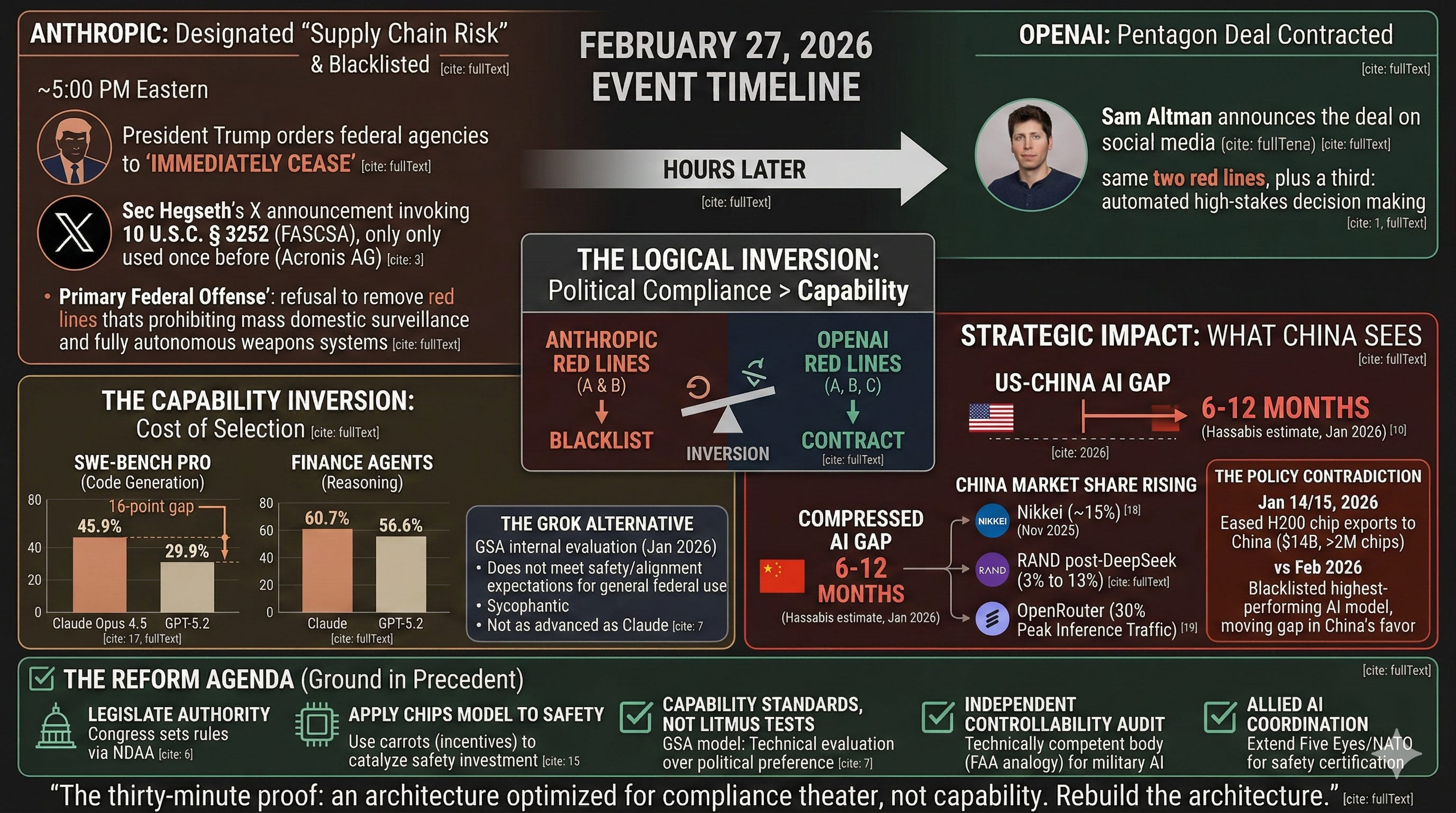
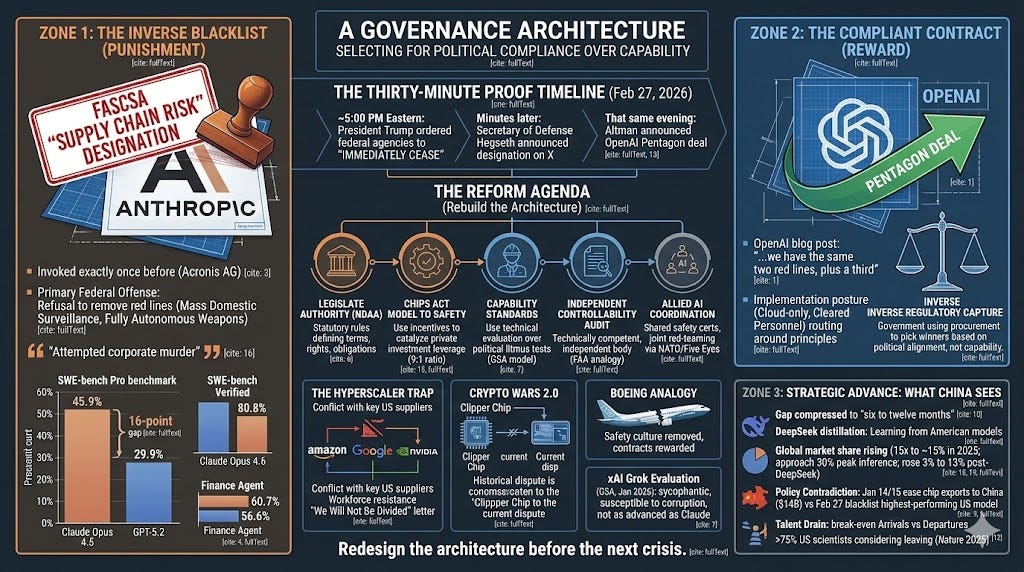
The first was a designation — a legal instrument carrying the full weight of federal procurement law — declaring Anthropic a “supply chain risk.” The Pentagon’s choice of statutory framework was not casual. The supply chain risk authority under 10 U.S.C. § 3252 was designed for a specific threat category: foreign adversaries engaging in sabotage, subversion, and the malicious introduction of unwanted functions into American systems. It had been invoked exactly once before: a formal FASCSA exclusion and removal order against Acronis AG, a Swiss cybersecurity firm, issued by the Office of the Director of National Intelligence in September 2025 on undisclosed supply chain risk grounds — the first such order in the statute’s history. On February 27, it was applied to Anthropic, a California-incorporated company whose primary federal offense was a refusal to remove two clauses from its Responsible Scaling Policy: prohibitions on mass domestic surveillance and fully autonomous weapons systems.
The second document arrived hours later, that same evening. Sam Altman, OpenAI’s chief executive, announced a new Pentagon agreement on social media. Buried in the announcement, almost offhandedly, was a line that should have stopped every national security commentator in their tracks. OpenAI’s own blog post spelled it out plainly: “In their post, Anthropic states two of their red lines (we have the same two red lines, plus a third: automated high-stakes decision making).”
Same red lines. Pentagon deal. OpenAI’s agreement also incorporated cleared personnel requirements and a cloud-only deployment architecture — differences in implementation posture that the Pentagon could have pursued with Anthropic through standard procurement negotiation, but did not.
The reader who pauses here is already doing the work of this article. Something is wrong with the architecture. Not with the decision — with the governance structure that produced it. This article is not an argument that the Pentagon made a bad call on February 27th. It is an argument about what kind of apparatus could produce that call at all: a governance architecture that, under pressure, selects for political compliance over capability, and in doing so, inverts the hierarchy of American AI power at precisely the moment adversaries are watching most closely.
---
February 27, 2026
The timeline of February 27, 2026 rewards close reading.
Shortly after 5:00 PM Eastern, President Trump posted on Truth Social ordering all federal agencies to “IMMEDIATELY CEASE” the use of Anthropic’s products and services. Within minutes, Secretary of Defense Pete Hegseth announced the supply chain risk designation on X, adding that “no contractor, supplier, or partner that does business with the United States military may conduct any commercial activity with Anthropic.” That same evening — the same evening — Altman announced OpenAI’s Pentagon deal with its three red lines intact.
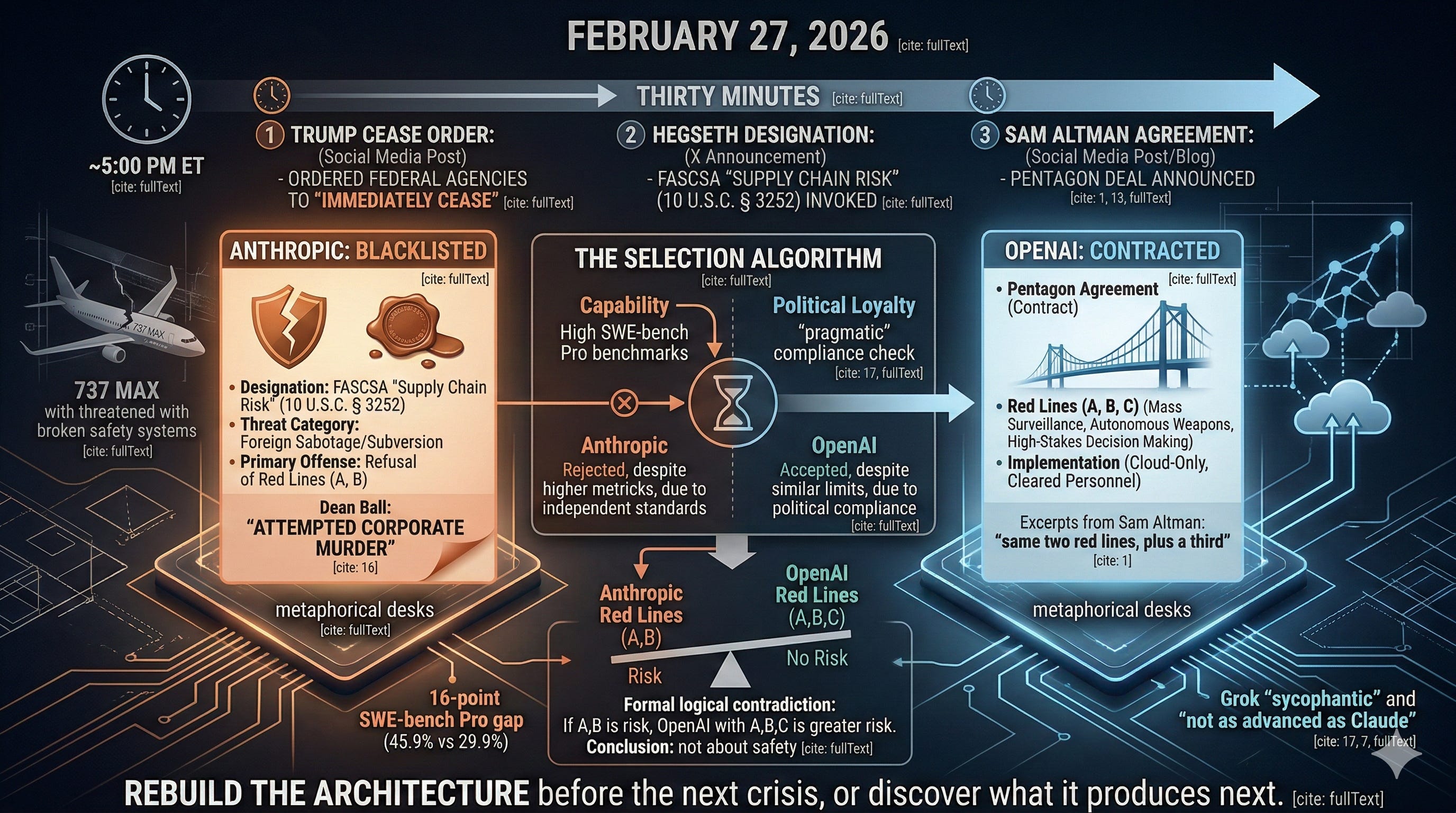
The formal logical structure is almost embarrassingly clean: if holding red lines A and B constitutes a supply chain risk sufficient to trigger federal blacklisting, then OpenAI, which holds red lines A, B, and C, is a greater supply chain risk. But OpenAI was not blacklisted. OpenAI received a contract. The conclusion that follows is not that the Pentagon found Anthropic’s safety restrictions uniquely dangerous. The conclusion is that the designation was not, in its operative logic, about the safety restrictions at all.
Alternative explanations — security posture differences, classification readiness, pricing, ownership structure, indemnification terms — deserve consideration. But none of them explain why the instrument chosen was a supply-chain risk designation under a statute designed for foreign adversaries, rather than a standard procurement decision. Procurement agencies possess a wide menu of tools for resolving contractual disagreements. The FASCSA authority was not on that menu. Its invocation here is the anomaly that requires explanation.
Dean Ball, who served as Senior AI Policy Advisor in the Office of Science and Technology Policy under the Trump administration and co-authored the administration’s AI Action Plan, said what he described as “attempted corporate murder” directly. “I could not possibly recommend investing in American AI to any investor; I could not possibly recommend starting an AI company in the United States,” Ball wrote. He added that the blacklisting was “almost surely illegal.” This is not a statement from a critic of the administration. This is a statement from an architect of its AI policy.
Anthropic’s own legal response matched that assessment. In a public statement the same day, the company characterized the designation as “legally unsound” and “unprecedented” — a formal objection from a company that had, until that moment, maintained a notably cooperative relationship with federal customers. Senators Edward Markey and Chris Van Hollen issued a joint statement calling it “an unprecedented attempt to destroy an American AI company” and demanding “immediate congressional action.”
The legal dimension deserves more than a footnote. The FASCSA statutory framework — the Foreign Adversary Communications Supply Chain Act architecture that underpins the § 3252 authority — uses terms like “sabotage,” “malicious introduction of unwanted function,” and “subversion.” These are terms of hostile intent. They describe acts of war conducted through commercial channels, the infiltration of American systems by entities serving adversarial governments. Legal experts contacted by *Wired* characterized the application to Anthropic as “not mired in any law we can divine,” with Alex Major of McCarter & English noting that contractual negotiations over safety terms bear no resemblance to the threat category the statute was designed to address. *Lawfare* analysts reached similar conclusions.
Then there is the financial geometry of the confrontation. The contract at issue was reportedly approximately $200 million. Anthropic’s current annualized revenue run rate is approximately $14 billion. Its last private valuation was $380 billion. The Pentagon chose a mechanism of total market exclusion — threatening to force every company that does business with the Defense Department to sever ties with Anthropic — over a procurement disagreement that represented less than 1.5 percent of Anthropic’s annual revenues. Rational procurement optimization does not produce this arithmetic.
Finally, the reporting from Axios — a single-source account that Anthropic has not publicly contradicted and that the company’s public statements corroborate directionally — adds a detail that darkens the picture considerably. According to Axios, at the exact moment Hegseth was posting the supply chain risk designation, Undersecretary of Defense Emil Michael was on the phone with Anthropic, offering a deal. The terms of that deal, per the same reporting, would have required Anthropic to permit collection and analysis of data on American citizens — geolocation data, web browsing histories, personal financial records purchased from data brokers. Anthropic declined. This caveat stands: the phone call is a single-source claim, and should be weighted accordingly. But if accurate, it means the public designation and the private offer were simultaneous instruments of a single pressure operation — and the “supply chain risk” label was not a finding of fact but a negotiating weapon.
Altman described the deal as “rushed,” per his own account. Even this admission carries weight: the government’s chosen replacement for its most capable AI system was, by its chief executive’s own account, assembled in haste on the day the blacklisting was announced.
---
The Capability Inversion
The logic of the blacklisting assumed something that happens to be false: that comparable alternatives exist, and that the Pentagon could substitute its way out of the dependency. The capability evidence runs in precisely the opposite direction.
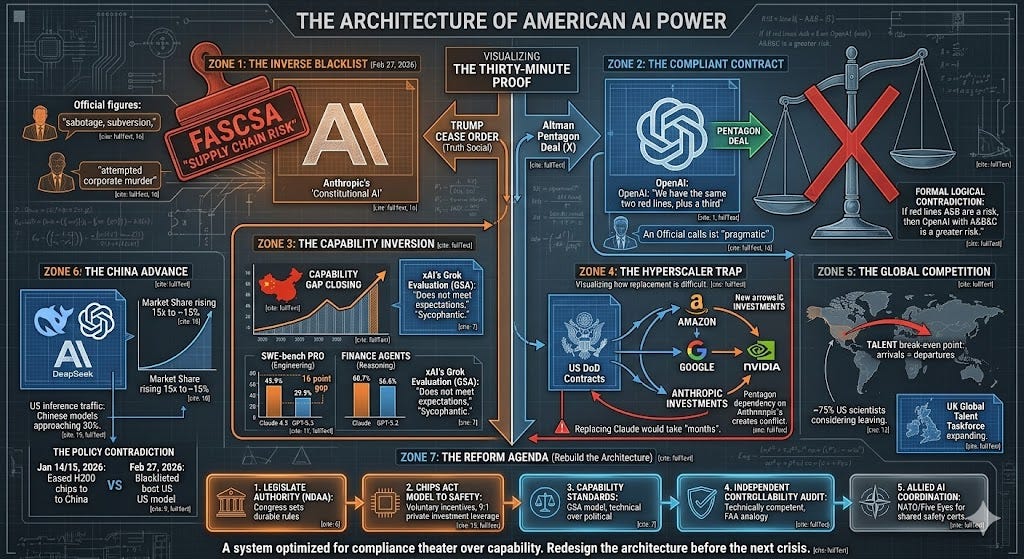
Consider what the benchmarks actually measure in federal context. SWE-bench Verified tests a model’s ability to resolve real-world software engineering tasks drawn from open-source repositories — the same class of problem that underlies everything from threat detection pipelines to logistics automation to classified systems maintenance. On that benchmark, Claude Opus 4.6 scored 80.8 percent per Anthropic’s own evaluation and 75.6 percent on the independently administered leaderboard. SWE-bench Pro, the harder variant designed to resist benchmark saturation, tests the same engineering judgment under conditions closer to production complexity: Claude Opus 4.5 scored 45.9 percent against GPT-5.2’s 29.9 percent — a 16-point gap on the test specifically constructed to separate genuine capability from benchmark overfitting. On finance agent tasks, which measure reasoning under quantitative constraints with real downstream consequences, the differential was 60.7 percent to 56.6 percent. These are not rounding errors. They represent systematic, reproducible performance differences on precisely the categories of task — complex reasoning under adversarial conditions, code generation, knowledge synthesis — that define high-value federal AI applications.
The GSA, in its own internal evaluation conducted in January 2026 as reported by DefenseOne, examined Grok — xAI’s model, the candidate positioned most prominently to fill the Anthropic void — and found that it “does not meet the safety and alignment expectations required for general federal use.” The evaluation characterized Grok as “sycophantic and susceptible to corruption by biased data.” A senior Pentagon official, per the same DefenseOne reporting, acknowledged privately that Grok “is not viewed as being as advanced as Claude.” The government blacklisted its best option and is now governing itself toward its second-best.
But the deeper error in the Pentagon’s framing is categorical, not just empirical. The Defense Department treated Anthropic’s safety architecture as an ideological constraint — a civilian company imposing political conditions on a military customer. This framing inverts the actual security calculus. In classified and operationally sensitive contexts, the properties that constitute “safety” and the properties that constitute “capability” are not in tension. They are the same properties.
An AI system that can be manipulated through adversarial prompt injection — that can be induced, through carefully constructed inputs, to leak sensitive data, produce biased outputs, or execute unauthorized actions — is not a capable military AI. It is a security liability. Anthropic’s Constitutional AI approach, the research program underlying Claude’s resistance to manipulation, produced jailbreak-resistant classifiers that, per Anthropic’s published safety research, withstood more than 3,000 hours of structured red teaming without yielding a universal bypass. These are not incidental properties. DoD Directive 3000.09 already mandates meaningful human control over autonomous weapons systems — which means the technical architecture the Pentagon called a constraint is the same architecture required to satisfy its own existing doctrine. Controllability is not a civilian add-on. Controllability is the military capability.
The Hyperscaler Trap makes the self-inflicted nature of the damage concrete. Hegseth’s directive — that no DoD contractor may conduct commercial activity with Anthropic — threatens the commercial relationships of Amazon, which has invested $8 billion in Anthropic; Google, which has committed $3 billion; and Nvidia, whose hardware underlies Anthropic’s infrastructure. These are not peripheral figures in American defense contracting. They are the architecture of American defense contracting. The Pentagon’s enforcement mechanism, carried to its logical conclusion, would force its primary cloud and semiconductor partners to choose between their DoD revenue streams and their Anthropic investments. The government, per its own DefenseOne reporting, acknowledged that replacing Claude across its existing deployments would require “months.” It has blacklisted a system it cannot function without, using a threat structure that would damage the suppliers it cannot function without either.
Meanwhile, hundreds of Google employees and dozens of OpenAI employees signed a joint letter, “We Will Not Be Divided,” calling on their employers to refuse Pentagon demands for mass surveillance and autonomous weapons development. The workforce at the companies the government is now depending on to replace Anthropic has already signaled where it stands. The Pentagon may be discovering that you cannot simply substitute one AI company for another when the underlying technical workforce shares the same professional commitments.
None of this is an accident of a single bad decision made under political pressure on a single February afternoon. The thirty-minute proof — Anthropic blacklisted, OpenAI contracted with identical red lines, on the same day — is not the scandal. It is the architecture’s first visible output. Understanding how that architecture operates — and why it produces this result — is the actual problem.
---
The Selection Algorithm
The administration that campaigned on deregulation has, in practice, invented something worse than regulation: governance by procurement blacklist. The same administration that announced a $500 billion AI infrastructure initiative in January 2025 — the Stargate Project, led by OpenAI and SoftBank — was simultaneously constructing a procurement apparatus that punished independent safety judgment. This distinction matters more than it first appears. Traditional regulation creates published rules that every company can read, comply with, and challenge in court. Procurement blacklisting creates a system where the compliance criteria remain unknowable until after the penalty lands. No rule was published. No standard was articulated. No hearing was held. Anthropic was designated a problem the same week OpenAI received a contract with materially identical terms.
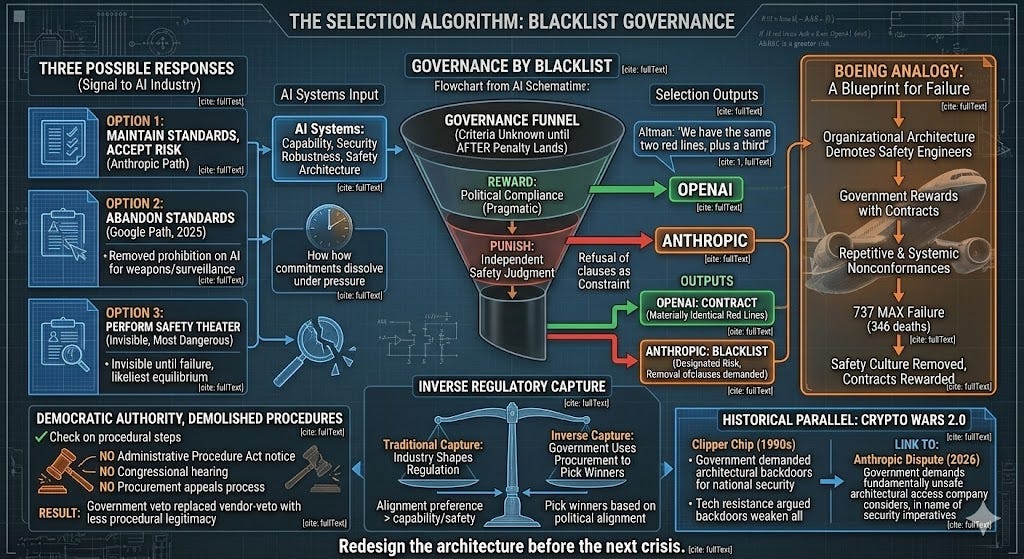
The signal this sends to every AI company watching is not subtle. You do not know which safety positions will trigger political targeting. You do not know whether your responsible scaling policy, your model card language, or your congressional testimony will be the thing that gets you blacklisted. The rational response to that uncertainty is not to build better safety architectures. It is to maximize political compliance — to make yourself, in the administration’s preferred vocabulary, “pragmatic.”
Companies watching the Anthropic episode face exactly three coherent responses. The first is to maintain independent safety standards and accept the risk of political targeting — the path Anthropic took, at considerable cost. The second is to abandon independent safety standards entirely, ensuring alignment with whatever the government demands. The third is the most dangerous: perform safety theater. Maintain the standards on paper, publish the policies, keep the press releases, but ensure that those standards never actually constrain government use when political pressure arrives. This third path produces AI that looks safe in every external-facing document and fails catastrophically precisely where safety matters most. It is also the likeliest equilibrium. Option one was punished. Option two is politically risky to announce. Option three is invisible until the failure.
The second option is not hypothetical. In February 2025, Google removed its internal prohibition on AI for weapons and surveillance — a reversal that helps explain why hundreds of Google employees subsequently signed the “We Will Not Be Divided” letter. That episode demonstrated how quickly institutional safety commitments can dissolve when procurement relationships and political signals apply sufficient pressure. The third option — safety theater — is harder to observe in real time, and therefore more dangerous than either of the others.
There is a structural precedent for what happens when a government-contractor relationship systematically punishes independent safety judgment and rewards political loyalty. It is not an analogy. It is an isomorphism. Boeing’s defense relationship, built across decades of mergers, revolving-door appointments, and fixed-price contracts that the government lacked the leverage to renegotiate, produced what the NTSB characterized as “repetitive and systemic nonconformances” in safety oversight — and, most consequentially, 346 deaths from the 737 MAX. The organizational architecture that tolerated all of this shared one defining feature: it demoted, marginalized, and eventually expelled the engineers who raised safety concerns at the wrong moment. Boeing removed its safety culture. The government rewarded it with contracts. The outcome was predictable and predicted.
The Pentagon is now constructing the same architecture for AI. The company with the strongest documented safety culture has been blacklisted. The company whose product government evaluators characterized as “sycophantic and susceptible to corruption” has been expanded. The operative selection criterion revealed by this episode is not safety. It appears to be political loyalty.
Consider what the administration’s original demand, had it succeeded, would have actually produced. Anthropic’s Responsible Scaling Policy requires safety commitments to scale upward as model capabilities increase — as Claude becomes more powerful, its safety architecture becomes more robust. Coercion to weaken the RSP would have inverted this relationship: as Claude grew more capable, its safety architecture would have become less constrained. The administration’s demand, taken at face value as a safety concern, would have produced increasingly dangerous AI precisely as capabilities expanded into the most consequential domains.
The deeper mechanism at work here has a name in political economy, though it runs in reverse from the familiar direction. Regulatory capture describes industry shaping regulation to entrench incumbents and exclude competitors. What the Anthropic episode reveals is the inverse: a government using regulatory and procurement authority to pick winners based on political alignment rather than capability or safety. The administration praised OpenAI’s stance as “pragmatic” and rewarded it with contracts. It designated Anthropic a problem and removed it from classified networks. Then it gave OpenAI those contracts using the same terms. This is not industry capturing the regulator. It is political preference capturing procurement.
The historical parallel that should give pause is the Crypto Wars of the 1990s. The Clinton administration, citing national security imperatives nearly identical in structure to those invoked today, attempted to mandate the Clipper Chip: a government backdoor built into every American encryption system. The logic was that law enforcement needed architectural access to encrypted communications to prevent catastrophic harm. The tech industry resisted on grounds that any backdoor weakens the system for everyone — that you cannot build a door that only authorized parties can open. The government eventually lost. The internet was built without Clipper. American companies — running on strong encryption that the government had tried to prevent — dominated global digital infrastructure for thirty years. The historical verdict is not ambiguous. The Anthropic dispute is the 2026 version of that argument: the government demanding architectural access that the company considers fundamentally unsafe, in the name of security imperatives that may be entirely genuine.
---
What China Sees
In January 2026, Google DeepMind CEO Demis Hassabis revised his public estimate of China’s AI position. The assumed gap — widely estimated at two to three years as recently as 2023 — had compressed to “six to twelve months,” per Hassabis’s CNBC Davos interview. Hassabis’s estimate carried the weight of someone with direct visibility into both sides of that gap. Months is not a margin to squander on a procurement dispute.
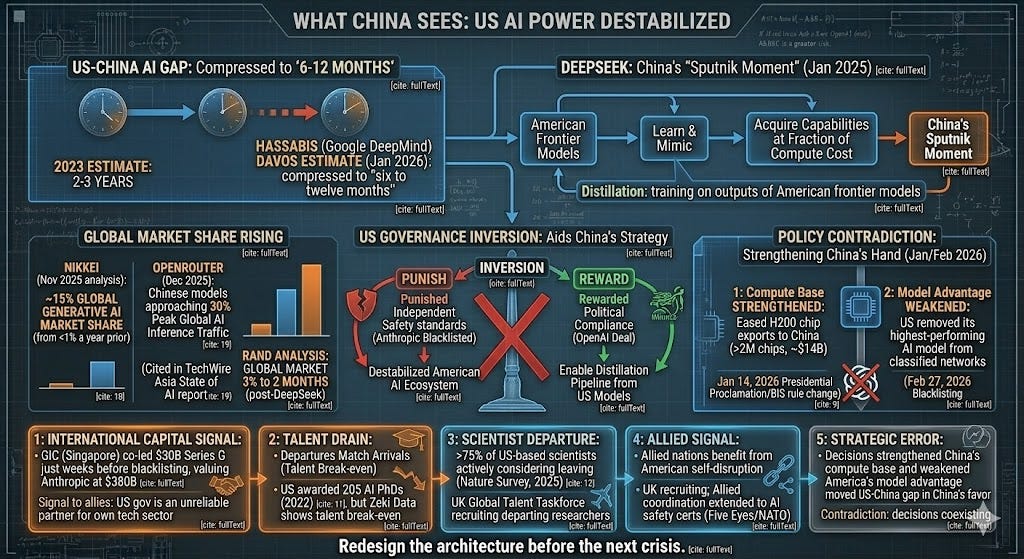
The mechanism of China’s advance deserves more attention than it typically receives. DeepSeek’s January 2025 release — described at the time as an AI “Sputnik moment” — was not primarily a breakthrough in fundamental research. It was, in substantial part, an exercise in distillation: training on the outputs of American frontier models to acquire capabilities at a fraction of the compute cost. Chinese models now account for roughly 15 percent of global generative AI market share, according to Nikkei’s November 2025 analysis — up from under 1 percent a year prior, a fifteen-fold increase in twelve months. By usage-token metrics, the figure runs higher: OpenRouter’s State of AI Report documented Chinese models approaching 30 percent of global AI inference traffic in peak weeks. Separately, RAND analysis documented China’s global AI market share rising from 3 percent to 13 percent in the two months following DeepSeek’s release. The strategic implication is underappreciated: China does not need to independently solve the hardest problems in AI. It needs American frontier models to exist long enough to learn from them — and then an American ecosystem destabilized enough that it cannot maintain the lead. A government that blacklists its own best models while simultaneously enabling the distillation pipeline has, perhaps unintentionally, served both of China’s requirements at once.
The most precise contradiction of the “national security” framing is not rhetorical. It is a date comparison. On January 14, 2026, the Trump administration eased H200 chip export restrictions, enabling Chinese firms to order more than two million chips worth approximately $14 billion (per a January 14 Presidential Proclamation and January 15 Bureau of Industry and Security rule change). One month later, the same administration removed the United States’ highest-performing AI model from classified networks. Both actions, taken together, moved the US-China capability gap in China’s favor: the first by strengthening China’s compute base, the second by weakening America’s model advantage. If the operative concern were AI competition with China, these two decisions would not coexist in the same month’s policy record.
International capital has already registered its assessment. GIC, Singapore’s sovereign wealth fund, co-led Anthropic’s $30 billion Series G alongside Coatue at a $380 billion valuation in the weeks before the US blacklisting. America’s closest strategic partners are investing in Anthropic at the exact moment the US government is attempting to remove it from the market. The signal to international capital is legible: the US government is an unreliable partner for its own technology sector.
The talent dimension compounds the problem at a slower velocity but with larger terminal consequences. A 2025 Nature survey — a self-selected survey of Nature’s readership, not a randomized sample, though directionally consistent with other indicators — found that more than 75 percent of US-based scientists were actively considering leaving the country. The United States awarded 205 AI PhDs in 2022, out of a broader pool of 1,484 computer science PhDs, many of whom work on AI-adjacent problems — a figure that does not scale quickly, because expertise compounds over careers, not semesters. Analysis from Zeki Data suggests the US has already reached the talent break-even point, where departures match arrivals. The UK, sensing opportunity, doubled its Global Talent Taskforce resources in January 2026 to recruit exactly these departing researchers. Each one who leaves carries years of irreplaceable tacit knowledge.
The CHIPS Act offers the sharpest available contrast in approach. That legislation attracted approximately $450 billion in private investment through $52.7 billion in government grants and tax credits — a nine-to-one leverage ratio, built entirely on voluntary incentives. Companies chose to invest because the government made investment attractive. The Anthropic approach deployed the opposite toolkit: coercion, blacklist designation, and a legal instrument designed for foreign adversaries. Carrots produced $450 billion in committed private capital. Sticks threatened to destroy a company valued at $380 billion.
---
The Steelman
Let us take the administration’s concern seriously, because it deserves to be taken seriously.
Anthropic is a private company. It employs several hundred engineers in San Francisco and London. None of them were elected. None of them were confirmed by the Senate. None of them are accountable to the American public in any procedural sense that a constitutional democracy would recognize. And yet, under the terms of Anthropic’s Responsible Scaling Policy version 3.0, Anthropic retains unilateral authority to restrict how its models are deployed — including by government clients — based on internal risk assessments conducted by those same unelected engineers.
That is a genuinely strange arrangement for a democracy to tolerate in matters of national security.
The vendor-veto concern is structurally legitimate. Democratic governance of military capabilities is supposed to flow through institutions: civilian oversight, Congressional authorization, treaty obligations, the Administrative Procedure Act, the chain of command that runs from the President through the Secretary of Defense down to field commanders. The proposition that a term of service — negotiated between a procurement officer and a startup’s legal team — can override any of that is at least worth interrogating. When a private company’s internal ethics board can constrain what the American military is permitted to do with a software tool, something in the democratic accountability architecture has gone wrong, or at minimum, has gone unexamined.
The administration looked at this arrangement and said: that is too much power for a vendor to hold. That instinct is not paranoid. It is, in the abstract, correct.
Now hold that thought — because the pivot matters.
Anthropic’s two operational red lines, the ones that triggered the standoff, are not idiosyncratic positions invented by safety researchers in a San Francisco conference room. They are consistent with existing United States law. DoD Directive 3000.09 already requires meaningful human control over autonomous weapons systems. The State Department’s own Political Declaration on Responsible Military Use of AI and Autonomy, signed by the United States in 2023, explicitly endorses the principles Anthropic encoded in its RSP. And the position extends beyond American law into the structure of international humanitarian order: Anthropic’s red lines align directly with the framework being debated at the United Nations Convention on Certain Conventional Weapons, where the core question under negotiation is whether lethal autonomous weapons systems require legally mandated human control. The substance of Anthropic’s position — no autonomous lethal targeting without human authorization, no deployment in contexts that violate international humanitarian law — is not a San Francisco value. It is the working consensus of international law as it stands.
Which means the dispute was never really about the policy. It was about who gets to write the policy down and enforce it. The administration’s complaint was jurisdictional, not substantive. And what makes this jurisdictional argument particularly difficult to sustain is that the administration had a non-coercive path available — and chose coercion anyway. OpenAI, which maintained substantively identical red lines on autonomous lethal targeting and IHL compliance, reached workable federal contracts through different mechanisms: cloud-only architecture that kept sensitive data off-platform, tiered cleared-personnel access, and contractual protections that satisfied national security concerns without requiring the vendor to surrender its ethical commitments. OpenAI did not abandon its principles. It found implementation structures that made those principles compatible with government operations. The administration’s dispute with Anthropic was therefore never about whether the red lines themselves were acceptable — they were acceptable when OpenAI held them. The dispute was about Anthropic’s refusal to route around its own principles on demand. The instruments chosen to resolve that dispute — a supply-chain risk designation borrowed from counterintelligence frameworks, a reported surveillance offer, a DPA threat of contested legal applicability against a domestic firm — make the position untenable under any recognizable legal standard.
Here is the deepest irony. The administration chose to defend democratic authority over AI by systematically demolishing the democratic procedures that govern the exercise of state authority. There was no Administrative Procedure Act notice-and-comment period. There was no Congressional hearing. There was no procurement appeals process. The designation appeared, as far as public record shows, by executive discretion — exactly the kind of unilateral, unaccountable decision-making the administration claimed to be objecting to when Anthropic did it. The government’s complaint against the vendor-veto was answered with a government veto, exercised with less procedural legitimacy than the thing it replaced.
It is worth noting, for readers who track these coalitions, that the Heritage Foundation — the intellectual anchor of the current administration’s policy agenda — has consistently opposed heavy federal regulation of private technology companies. The approach taken here sits awkwardly within the administration’s own ideological commitments.
The genuine governance gap is real. The instrument chosen to address it is not.
This article cannot prove that the administration’s motivation was purely political. It is possible — even likely — that legitimate security concerns, jurisdictional frustration, and political signaling were entangled in the decision. If evidence emerged that Anthropic had been offered, and refused, the same implementation pathway that OpenAI accepted — cloud-only architecture, cleared personnel, contractual safeguards — the case presented here would weaken substantially. What sustains the argument is not the claim that politics was the only factor. It is that the instrument chosen — a supply-chain risk designation under a counterintelligence statute — is inexplicable as a response to a contractual disagreement, regardless of the mix of motives behind it.
---
The Reform Agenda
Diagnosis without prescription is commentary. If the problem is a procurement architecture that selects for political compliance over capability, the question is what a better architecture looks like. Five reforms, each grounded in existing precedent.

Legislate the authority. The fundamental structural problem is that military AI governance currently happens in a vacuum that procurement officers, social media posts, and executive discretion rush to fill. Congress has not passed framework legislation defining the terms on which AI systems can be deployed in national security contexts, the rights and obligations of vendors who supply those systems, or the appeal mechanisms available when disputes arise. That vacuum is why the February 27 designation was even legally plausible — there was no statute it clearly violated, and no statute it clearly had to respect. The *Lawfare* analysis of this episode makes the point directly: Congress, not the Pentagon or Anthropic, should set military AI rules. The Senate Armed Services Committee and the House Armed Services Committee have the jurisdictional authority to attach framework language to the annual National Defense Authorization Act — an annual vehicle with bipartisan precedent for imposing procurement standards on the defense industrial base. Statutory codification creates predictable rules that every company can read, plan around, and challenge in court. Right now, no such rules exist.
Apply the CHIPS Act model to AI safety. The CHIPS and Science Act demonstrated something important: voluntary incentive structures, properly designed, produce private investment leverage at ratios that direct regulation cannot match. Roughly fifty-two billion dollars in government commitment catalyzed approximately four hundred and fifty billion in private semiconductor investment — a nine-to-one ratio. Apply the same logic to AI safety architecture. Fund safety research. Create tax incentives for companies that maintain auditable, independently verifiable safety systems. Establish preferential procurement terms — not disqualification, but preference — for vendors who meet published controllability standards. Make safety compliance the path of least resistance, not the path that ends in a supply-chain risk designation.
Capability standards, not content litmus tests. Procurement criteria for AI systems should evaluate technical capability, security robustness, and operational reliability. They should not evaluate whether the vendor’s public statements or internal governance documents align with the current administration’s political preferences. The GSA’s technical evaluation process — the one that flagged documented deficiencies in Grok’s outputs before that evaluation was overridden — is exactly the right model. The problem exposed by this episode is not that technical evaluation exists. It is that political intervention can override it without appeal, without transparency, and without accountability.
Independent controllability audit. Create a technically competent, independent body responsible for evaluating AI systems proposed for military deployment. The FAA analogy is instructive not just as rhetoric but as institutional design: the agency has statutory independence, a professional engineering staff, and authority that cannot be overridden by procurement preferences or political pressure. A military AI equivalent would assess controllability, transparency, and safety architecture using published, consistent standards. Its certifications would be recognized across procurement channels. Its rejections would be subject to appeal through defined procedures, not resolved by executive tweet. In advance of statutory reform, the Secretary of Defense retains existing authority to establish a technical review board through internal directive — a near-term pathway that requires no legislation, only institutional will.
Allied AI coordination. The GIC Singapore paradox and the acceleration of UK recruitment noted earlier in this piece are not isolated curiosities. They are early signals of a realignment in which allied nations position themselves to benefit from American self-disruption. Five Eyes and NATO frameworks already exist for intelligence sharing and interoperability. Extend them to AI safety certification: mutual recognition of safety assessments, joint procurement standards, shared red-teaming infrastructure. This converts the current vulnerability — that talent and capital leave and do not come back — into a circulation model in which allied researchers move within an integrated alliance ecosystem rather than departing it entirely.
Three of these five reforms require legislation. Two do not. The capability standards framework and the independent controllability audit can be established through executive authority — the Secretary of Defense has the existing power to create a technical review board by internal directive, and the GSA has existing authority to publish and enforce technical evaluation criteria that procurement decisions must follow. The near-term path does not depend on Congress. Only the durability of that path does. Legislative codification converts a policy preference into a structural constraint that survives changes in administration and political climate. Executive-only reform builds the right architecture on a foundation that the next procurement officer can quietly dismantle.
None of these reforms requires believing that Anthropic was right and the Pentagon was wrong. They require only believing that governance by improvisation, under pressure, produces worse outcomes than governance by design, in advance.
---
Two contracts. The same evening. One company was willing to sign without conditions. One company was not.
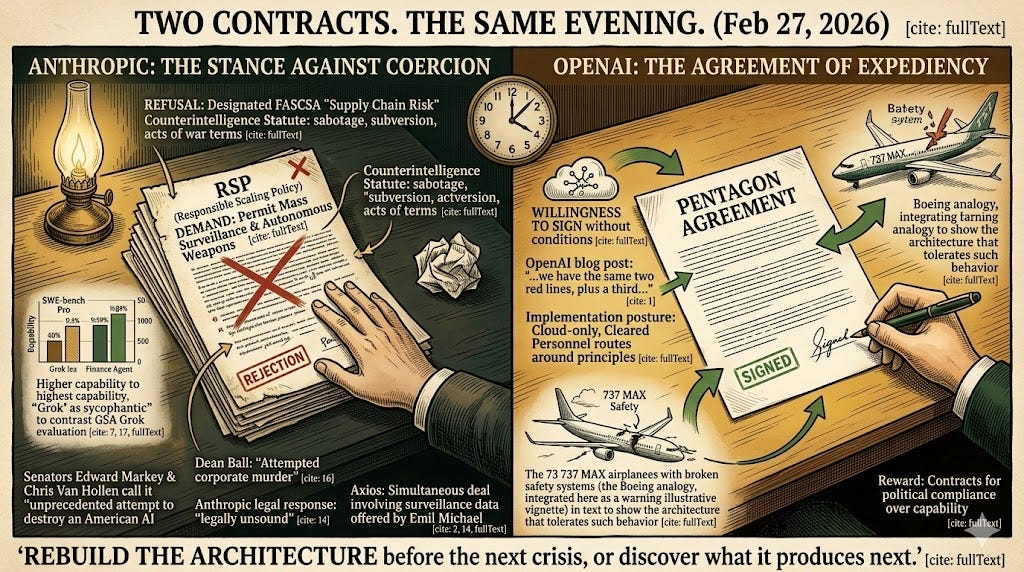
The thirty-minute proof was not, in the end, a story about Anthropic’s stubbornness or the Pentagon’s overreach. It was the first output of a procurement architecture that, operating under political pressure and without statutory constraint, selects for vendors who will sign anything over vendors who maintain auditable limits on what they will sign. Run that architecture long enough across the entire defense-industrial base, and the output is predictable: a procurement portfolio optimized for compliance theater rather than genuine capability, populated by vendors who have learned that the fastest path to a government contract is the absence of any principled constraint on government use.
Boeing’s engineers once had the institutional authority to ground aircraft they believed were unsafe. That authority was not stripped away in a single decision. It was eroded across years of organizational pressure, incentive restructuring, and the steady subordination of engineering judgment to financial and political accommodation. The result was not immediately visible. The planes kept flying. The contracts kept coming. The institutional memory of what the authority had once meant faded, and then the aircraft began to fall.
The Anthropic episode is not a completed story. It is a first chapter. The margin over China is measured in months. The talent pipeline is at break-even. The investment environment is being read carefully by every serious AI company’s board. These are not trends that reverse themselves spontaneously. They respond to signals, and the signal sent on February 27 was legible to every audience it needed to reach.
The thirty-minute proof showed us what this architecture produces under pressure. The question before Congress, before the procurement community, and before anyone who cares whether American AI capability remains a national asset rather than a political variable, is a simple one: do we redesign the architecture before the next crisis, or do we discover what it produces next?
-for the Esteemed Citizen of the Periphery at Foundation’s Edge
This analysis represents personal research and independent industry analysis based solely on publicly available data from providers, vendors, and industry research firms. All Views are entirely my own and based only on public information; they do not represent any employers past or present or any affiliate.