

The Cognitive Arbitrage Window: Why Decomposition-Synthesis Mastery Is the Meta-Skill of the AI Era
The uncomfortable truth about who actually benefits from AI—and what you must do to be among them

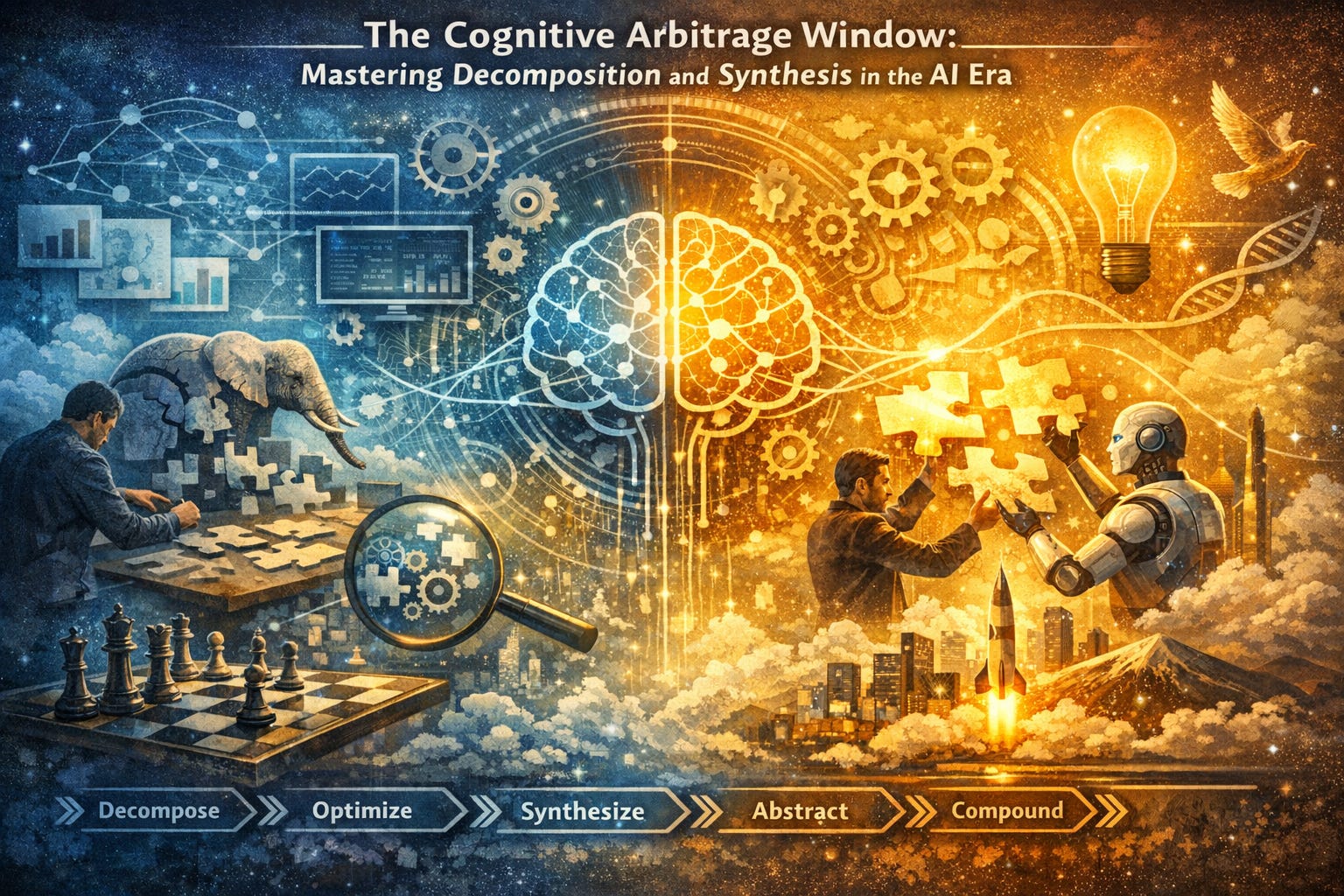
The Finding Nobody Wants to Hear
Let’s begin with the study that should unsettle every AI optimist.
A 2024 meta-analysis published in Nature Human Behaviour, reviewing 106 studies on human-AI collaboration, found something that contradicts nearly every productivity narrative you’ve encountered: human-AI combinations often underperform the best individual performer—whether that’s a human working alone or an AI working alone.
The effect size was negative (Hedges’ g = −0.23). In decision-making tasks where humans over-relied on AI, performance dropped even further (g = −0.54). The researchers found that neither explanations nor confidence metrics from AI reliably improved outcomes.

Read that again. The teams weren’t just failing to achieve synergy. They were doing worse than their best member would have done solo.
This finding should be the starting point for any serious conversation about AI’s role in human capability—not the breathless productivity statistics that dominate the discourse. If you understand why this happens, you understand what actually separates those who will thrive with AI from those who will be degraded by it.
The difference isn’t access to tools. It isn’t prompting skills. It isn’t even domain expertise, though that matters. The difference is whether you’ve developed the cognitive architecture that allows you to maintain what I call epistemic sovereignty—the capacity to think independently while leveraging AI’s parallel exploration capabilities.
That architecture has a name. It’s the ancient and underappreciated dual skill of decomposition and synthesis.
The Elephant Problem: What Decomposition and Synthesis Actually Mean
Peter Senge, the systems thinking pioneer, captured something essential: “Dividing an elephant in half does not produce two small elephants.”
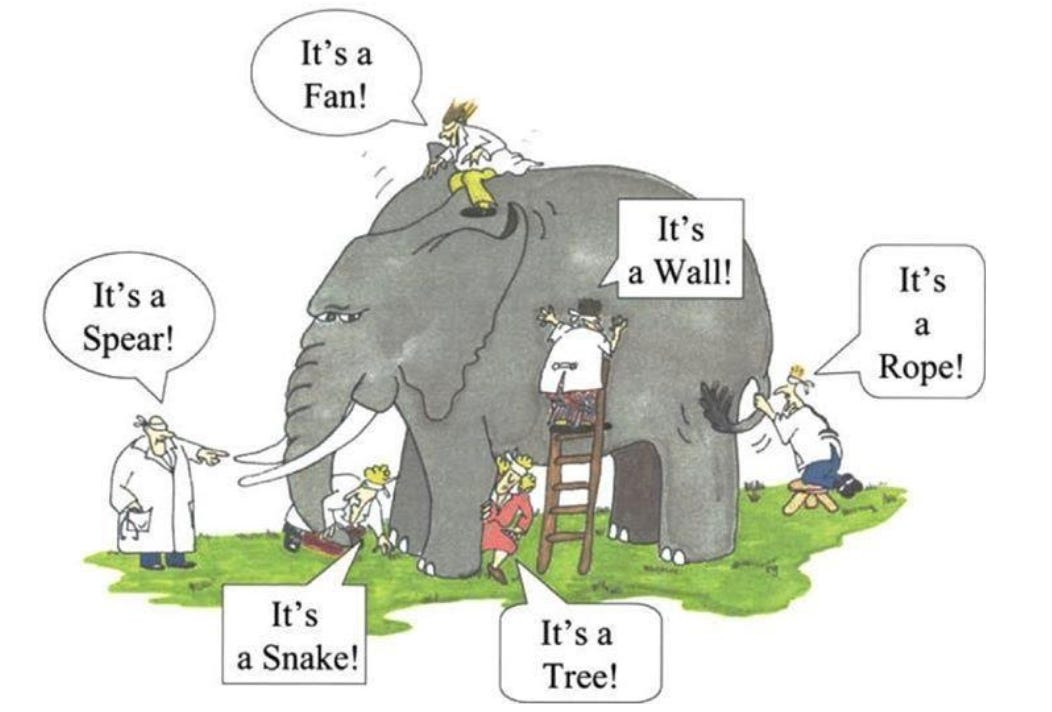
This is the most common misunderstanding about decomposition. People confuse it with “making lists” or “breaking things into pieces.” But the skill that matters isn’t the breaking—it’s understanding where the joints are that allow breaking without destruction.
Decomposition is the disciplined ability to identify the boundaries, constraints, and invariants that define a complex problem. It’s choosing which cuts preserve meaning and which destroy it. A chess master looking at a board position doesn’t see 32 pieces—they see 50,000 to 100,000 meaningful patterns stored in long-term memory, each representing a decomposition schema that preserves strategic coherence.
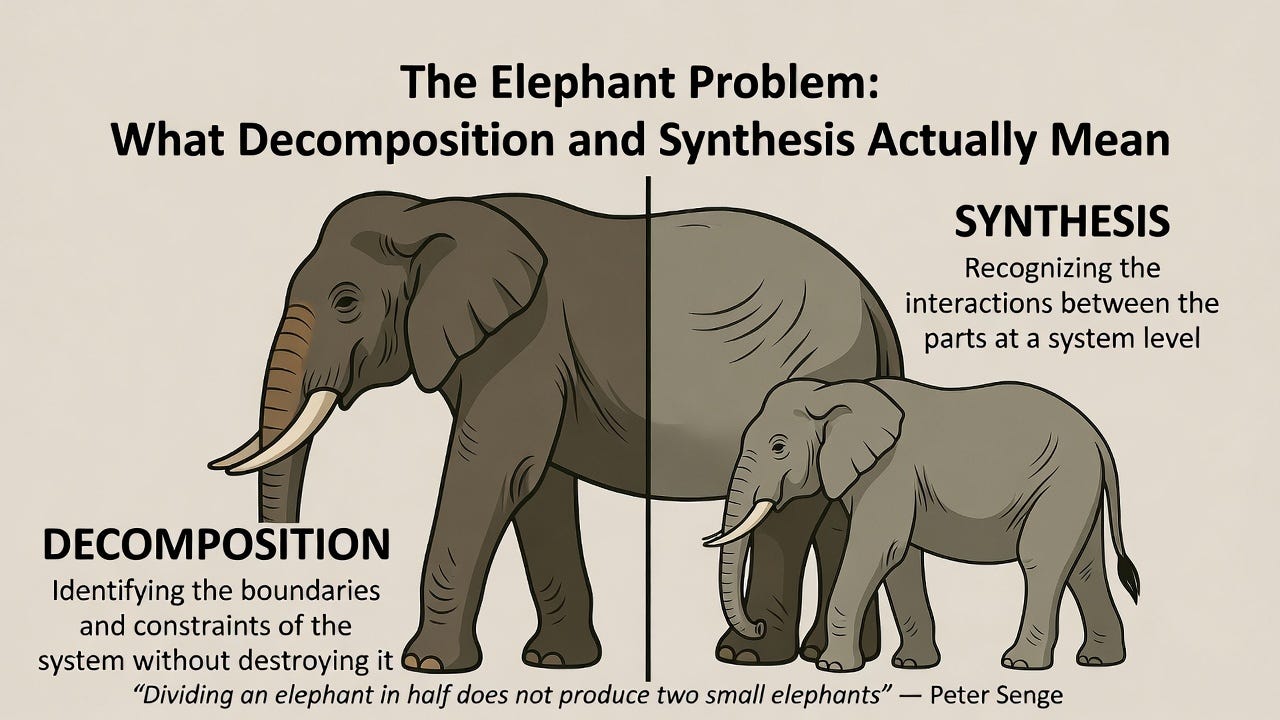
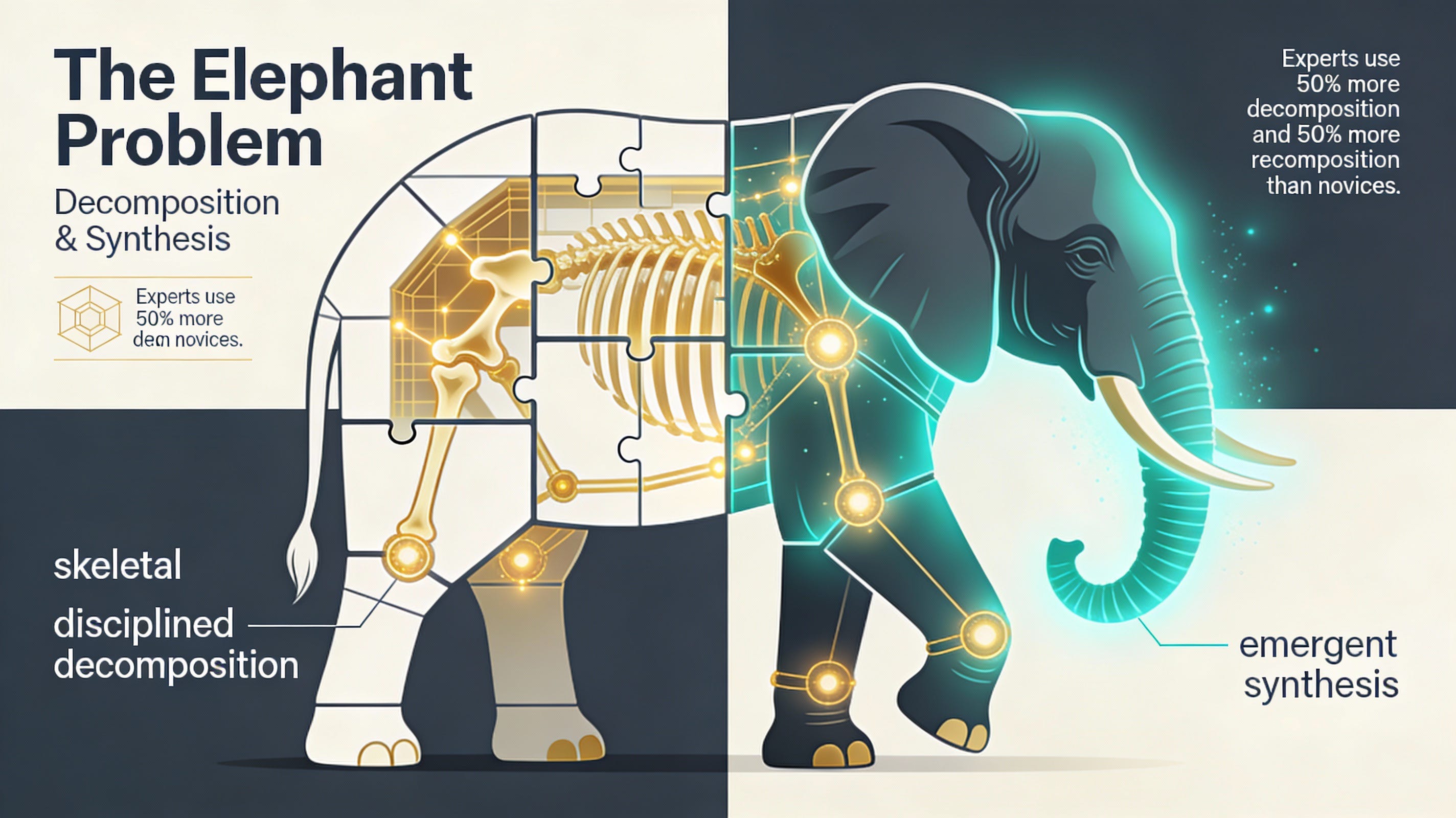
Synthesis is the complementary skill of integration—not reassembly, but the recognition of how components interact to produce properties that exist only at the system level. The elephant’s animating purpose exists in no single organ. The value of a business strategy emerges from interactions among its elements. A scientific theory synthesizes observations into explanatory power greater than any individual data point.
Engineering design research reveals something striking about these skills: professional designers use 50% more decomposition and 50% more recomposition than students. The two capabilities develop together and reinforce each other. Neither is sufficient alone.
Here’s the first principles insight: expertise itself is the accumulation of progressively more sophisticated decomposition-synthesis cycles. Herbert Simon’s research on chess masters, Chi’s studies of physics problem-solving, and decades of expert-novice research converge on this point. Experts perceive problems through deep structure (underlying principles) while novices perceive them through surface features (objects and appearances). This difference isn’t intelligence—it’s the accumulated residue of thousands of decomposition-synthesis cycles that have been internalized as pattern recognition.
The cycle looks like this:
Decompose the problem space into tractable components
Optimize individual elements (increasingly with AI assistance)
Synthesize solutions with awareness of interactions and emergence
Abstract transferable patterns from the completed cycle
Compound enhanced capability into progressively more sophisticated problems
Each revolution of this wheel builds the cognitive infrastructure for more ambitious subsequent revolutions. It’s a flywheel, not a checklist.
The Historical Precedent
This isn’t new. The decomposition-synthesis dynamic appears throughout the intellectual history of breakthrough thinking, though rarely named explicitly.
Daniel Kahneman’s System 1/System 2 framework maps directly onto this dynamic. System 2—deliberate, effortful, step-by-step reasoning—performs the decomposition work. System 1—fast, automatic, pattern-based intuition—executes synthesis instantly. Kahneman’s crucial insight: “Other mental activities become fast and automatic through prolonged practice.” Expert intuition develops when System 2 deliberate practice becomes internalized as System 1 pattern recognition. The radiologist who “just sees” the tumor has decomposed thousands of images into diagnostic categories until synthesis became automatic.
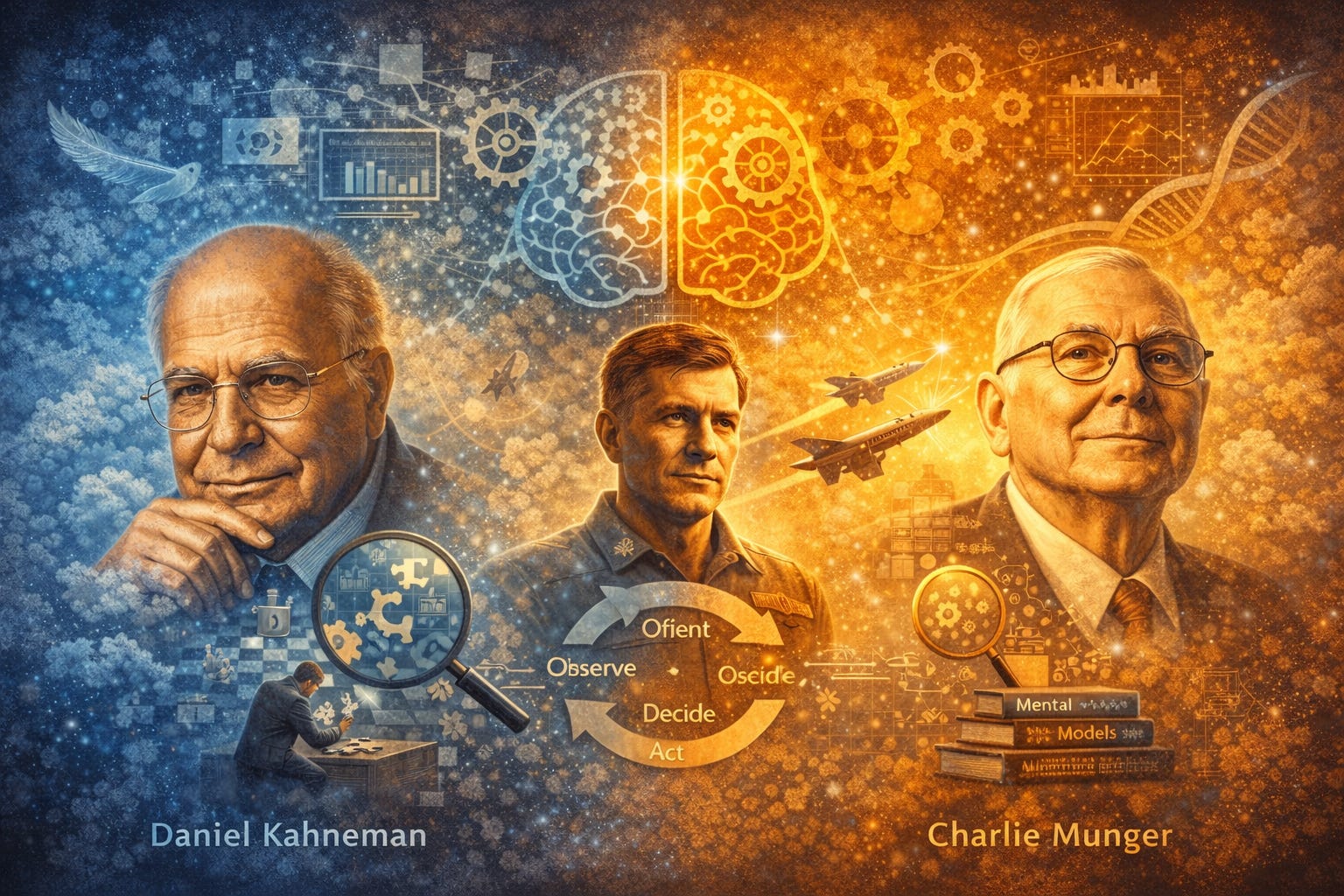
John Boyd’s OODA loop (Observe-Orient-Decide-Act) embeds decomposition-synthesis as the core competitive dynamic. Boyd’s biographer describes the expert state: “When one has developed the proper Fingerspitzengefühl for a changing situation, the tempo picks up and it seems one is then able to bypass the explicit ‘Orientation’ and ‘Decision’ part of the loop.” This isn’t skipping steps—it’s having internalized the decomposition so thoroughly that synthesis appears instantaneous.
Charlie Munger’s mental models represent perhaps the most explicit endorsement of the framework. Munger insists: “You’ve got to have models in your head. And you’ve got to array your experience—both vicarious and direct—on this latticework of models.” Each mental model provides a different decomposition lens; the latticework enables synthesis across frameworks. Warren Buffett attributes Munger’s legendary “thirty-second mind” to this rich latticework enabling rapid pattern matching and integration.
What these frameworks share is recognition that effective thinking cycles between breaking apart and putting together. But they were all developed before AI made it possible to run dozens of these cycles simultaneously.
Why AI Changes the Economics (Not Just the Speed)
The evidence for AI-enabled productivity amplification is now substantial:
55.8% faster task completion for GitHub Copilot users
40% reduction in completion time and 18% quality improvement for professional writing tasks (MIT study)
12.2% more tasks, 25.1% faster, 40% higher quality in BCG’s 758-consultant randomized trial
10-14x compression of iteration cycles in product development (2-4 weeks → next day)
~95% time savings on information compilation tasks (Anthropic Economic Index)
But here’s what these statistics miss: the gift isn’t velocity. It’s parallelism.
Traditional decomposition-synthesis cycles are sequential. You form a hypothesis, test it, learn from the result, adjust, and try again. Each iteration takes time. The number of cycles you can complete in a career is bounded by human lifespan and cognitive endurance.
AI collapses the marginal cost of generating and testing hypotheses to near zero. Research on parallel prototyping shows that exploring multiple concepts simultaneously produces 56% higher usability just by picking the best of four parallel designs, and 70% higher when merging insights across parallel tracks.
What this means: someone skilled at decomposition can now simultaneously explore multiple decomposition strategies, test each rapidly, and synthesize the results—all before a less skilled competitor finishes their first draft.
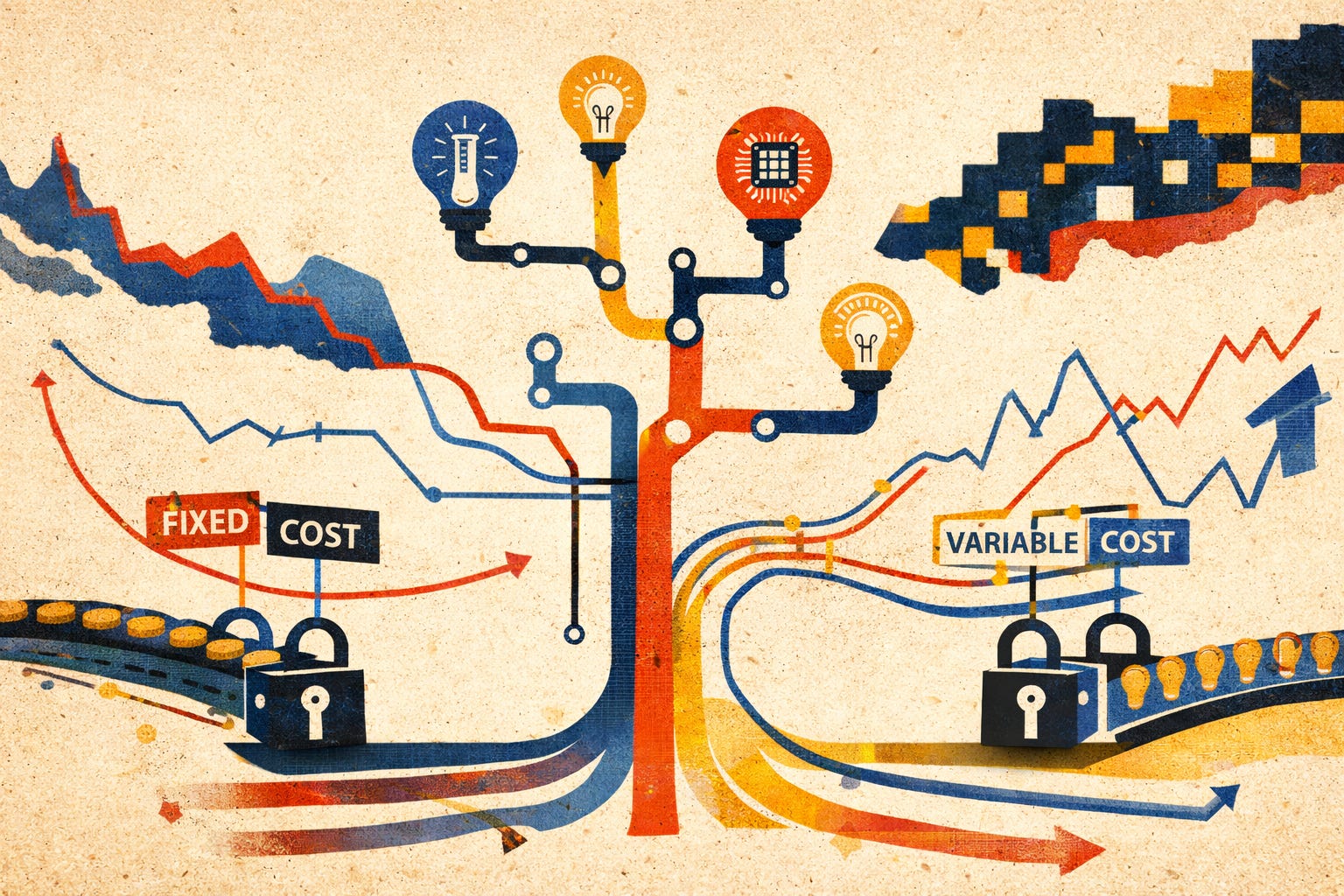
I call this capability Rapid Iterative Parallelism. When combined with disciplined first-principles thinking—the practice of decomposing problems to fundamental truths rather than conventional assumptions—it transforms what’s possible.
Consider Elon Musk’s famous rocket cost analysis: “What is a rocket made of? Aerospace-grade aluminum alloys, plus some titanium, copper, and carbon fiber. What is the value of those materials on the commodity market?” The answer revealed a 98% gap between material costs and market prices. The synthesis—vertical integration, reusability, in-house manufacturing—reduced launch costs from $380 million to $67 million.
That’s first-principles decomposition followed by radical synthesis. AI didn’t exist when Musk started that analysis. But now imagine running dozens of such analyses in parallel across different industries, testing each against market data in real time, with AI handling the information compilation while you direct the decomposition strategy and evaluate the synthesis opportunities.
The bottleneck shifts from can I gather and process enough information to do I have the judgment to know what questions to ask, which decomposition frames matter, and how to synthesize genuinely novel combinations.
This is the cognitive arbitrage window. AI commoditizes information processing. Decomposition-synthesis mastery becomes the scarce resource that determines who captures value.
But here’s the crucial asymmetry most observers miss: AI excels at executing decomposition strategies—breaking problems into components, generating multiple framings, exhaustively cataloging options—while synthesis remains stubbornly human. The recognition of which decomposition matters, the judgment of how pieces fit together, the creation of genuinely novel combinations that no training data anticipated: these cannot be outsourced without destroying the value they create.
The future belongs not to pure decomposers (AI handles that) nor to those who avoid decomposition entirely. It belongs to those who master the decomposition-synthesis dialectic—and maintain the discipline to keep AI as a tool rather than a crutch.
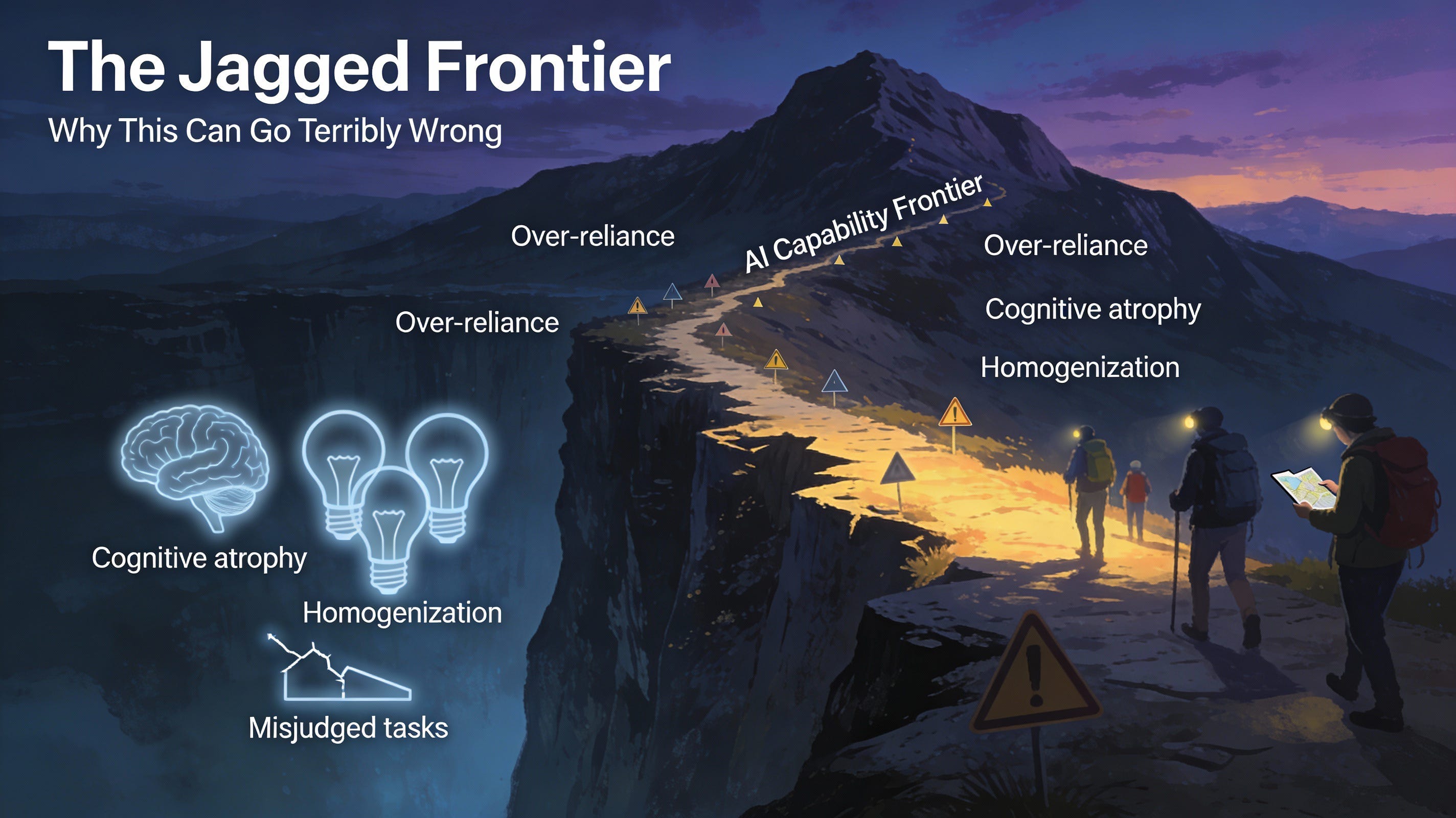
The Jagged Frontier: Why This Can Go Terribly Wrong
The BCG study contains a finding more important than its headline productivity gains.
For tasks inside AI’s capability frontier, AI dramatically helped everyone—especially lower performers. But for tasks outside that frontier, consultants using AI performed 19 percentage points worse than those without.

Worse: users couldn’t reliably tell which tasks fell on which side of the frontier. The boundary is “jagged and non-obvious.”
This maps directly to what the cognitive science literature calls the expertise reversal effect. Instructional techniques that help novices can actively impair experts—and vice versa. The scaffolding that accelerates learning for beginners becomes a crutch that prevents advanced practitioners from developing fluid, integrated understanding.
The risks are real and empirically documented:
Cognitive Atrophy
Research from SBS Swiss Business School found a significant negative correlation between frequent AI usage and critical thinking abilities, with younger heavy users (ages 17-25) showing lower critical thinking scores. Multiple randomized trials in education document a troubling pattern: students perform better with AI tools but perform worse when the tools are removed, suggesting reliance on AI bypasses the cognitive processes essential for building genuine capability.
A Technology in Society study (2026) identifies a “creative scar”: upon AI withdrawal, creative performance drops while content homogeneity continues to increase. Users experience a “creativity illusion”—AI augments performance without fostering real creative ability.
One researcher frames the risk precisely: “not immediate intellectual decline but a gradual reconfiguration of cognitive effort: from comprehension to prompting, from synthesis to verification.”
Homogenization
Perhaps the most concerning finding for collective innovation: experiments published in Science Advances found that while AI enhances individual creativity, it reduces the collective diversity of novel content. AI-enabled stories were more similar to each other than human-only stories.
Research measuring “diversity growth rate” demonstrated that each additional human-written essay contributes more new ideas than a GPT-generated essay, with the diversity gap widening as scale increases. Cross-model research found “striking overlaps” in outputs from entirely different AI architectures—despite technical diversity, models recycle the same phrases, frames, and ideas.
This creates what researchers call a “social dilemma”: individually, writers are better off with AI assistance; collectively, a narrower scope of novel content emerges. For decomposition-synthesis at societal scale—the engine of breakthrough innovation—this homogenization effect threatens the cognitive diversity that breakthrough thinking requires.
The Expertise-Contingent Paradox
The Brynjolfsson study of 5,172 customer support agents found AI assistance increased productivity by 14-15% on average—but the distribution was telling. Novices improved by 34%; highly skilled workers showed “minimal impact.”
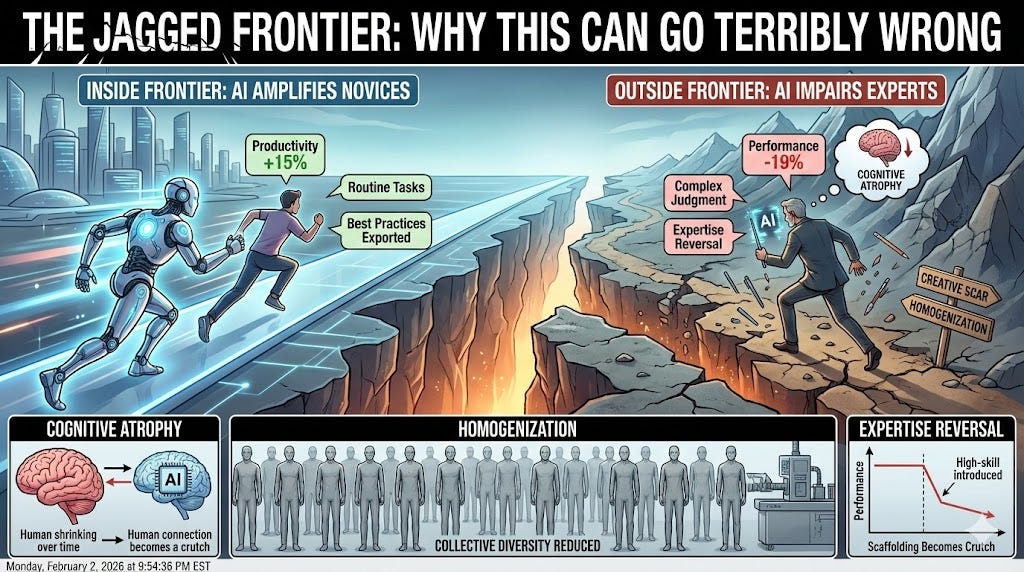
At first, this looks like democratization: AI levels the playing field. But dig deeper. Customer support is relatively routine work with clear correct answers. For such tasks, AI exports the best practices of top performers to everyone else.
For complex judgment tasks—exactly where decomposition-synthesis mastery matters—the pattern reverses. The BCG follow-up showed those with coding experience (the “engineering mindset” of breaking problems into verifiable subcomponents) performed 10-20 percentage points better than novices even when coding wasn’t directly involved.
The implication: AI commoditizes skill advantages for routine tasks while amplifying existing advantages for complex judgment tasks. As work shifts toward complexity—the consistent trend over four decades of labor market data—the premium on decomposition-synthesis skills will accelerate, not diminish.
Economic Headwinds
Two Nobel laureates have sounded alarms. Daron Acemoglu estimates that 50-70% of U.S. wage inequality growth between 1980-2016 was caused by automation and projects AI will generate only modest productivity gains (0.53-0.66% over ten years)—”disappointing relative to the promises.”
Erik Brynjolfsson’s “Turing Trap” analysis argues that the emphasis on automation rather than augmentation is “the single biggest explanation” for rising billionaires while average real wages fell.
Harvard Business Review research (2025) documents that “most organizations are still struggling to generate meaningful returns from their AI initiatives.” Only 8% of firms engage in core practices supporting widespread AI adoption. An MIT study found AI adoption initially caused a 1.33 percentage point productivity decline, with management practice deterioration accounting for nearly one-third of the losses.
The much-cited statistic: 95% of companies are failing to realize significant AI value despite widespread adoption.
The Winner-Take-All Dynamic
A deeper structural concern: even when decomposition-synthesis mastery creates value, that value may concentrate rather than distribute.
Sherwin Rosen’s economics of superstars shows that technology concentrates returns among a small elite. Research found that approximately one-third of U.S. income inequality growth since 1980 can be explained by the gap between compensation at superstar firms versus elsewhere.
The simulation study by Pluchino, Biondo, and Rapisarda found something uncomfortable: talent follows a normal distribution while wealth follows a power law—suggesting “hidden ingredients” beyond skill. Their key finding: “The most successful individuals are not the most talented ones.” Instead, “mediocre-but-lucky people were much more successful than more-talented-but-unlucky individuals.”
This doesn’t refute the value of decomposition and synthesis skills—the evidence that they correlate with outcomes is overwhelming. But it refutes naive meritocratic framings. Skills matter and interact with luck, networks, capital access, and timing in ways that individual effort cannot fully control.
The honest conclusion: decomposition-synthesis mastery is necessary but not sufficient. Structural factors determine who gets the opportunities to deploy these skills at consequential scale.
The Framework: Epistemic Sovereignty Through the Cognitive Flywheel
Given the genuine opportunities and documented risks, what’s the operating system for capturing value?
I propose the Cognitive Flywheel—a six-step framework that integrates decomposition-synthesis mastery with deliberate AI augmentation while maintaining the epistemic sovereignty that prevents cognitive atrophy.
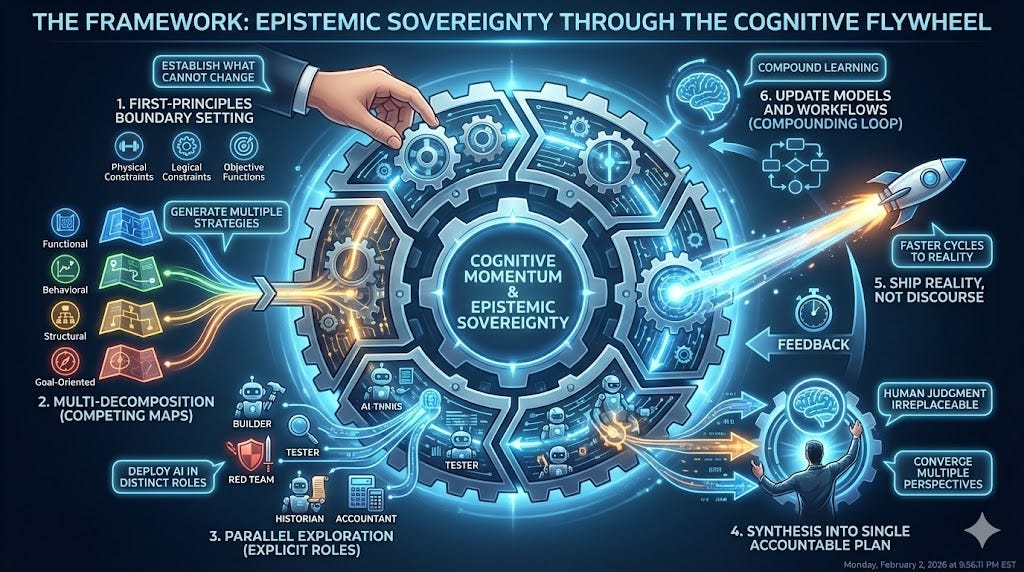
Step 1: First-Principles Boundary Setting
Before decomposing anything, establish what cannot change:
What are the physical constraints (laws of nature, material properties)?
What are the logical constraints (mathematical necessities, definitional truths)?
What are the objective functions (what must a solution actually accomplish)?
This prevents the common failure of decomposing along conventional rather than fundamental dimensions. The conventional boundaries often encode assumptions that should be questioned, not preserved.
AI role: Use AI to challenge your boundaries. Prompt for: “What assumptions am I making that a first-principles analysis would question?” “What constraints in this problem are physical versus conventional?”
Step 2: Multi-Decomposition (Competing Maps)
Generate multiple decomposition strategies before committing to one. Different decomposition frames reveal different structure:
Functional decomposition: What does each component do?
Behavioral decomposition: How does each component act over time?
Structural decomposition: What is the physical/organizational architecture?
Goal-oriented decomposition: What outcome does each component serve?
Expert-novice research shows professionals employ breadth-first decomposition—mapping the entire problem space before diving into details—while novices use inefficient depth-first approaches that miss systemic relationships.
AI role: Generate decomposition alternatives in parallel. “Decompose this problem by function, by behavior, by structure, and by stakeholder goals. Compare what each reveals.”
Step 3: Parallel Exploration with Explicit Roles
This is where AI augmentation becomes powerful. For each major decomposition branch, deploy AI in distinct roles:
Builder: Generate solutions, prototypes, implementations
Tester: Stress-test solutions against edge cases
Red Team: Find failure modes, attack assumptions
Historian: Surface relevant precedents, prior art, analogous solutions
Accountant: Quantify costs, trade-offs, second-order effects
The explicit roles prevent the homogenization that occurs when AI outputs are treated as neutral answers. Each role produces a perspective; synthesis requires you to integrate perspectives, not accept them.
Critical discipline: Document your independent reasoning before seeing AI outputs. This preserves the cognitive work that builds capability.
Step 4: Synthesis into Single Accountable Plan
Multiple perspectives must converge into a single coherent strategy that you can defend and execute. This is where human judgment proves irreplaceable.
Synthesis requires understanding:
Which component optimizations interact (you can’t maximize them independently)
What emergent properties appear only at the system level
Which trade-offs cannot be avoided, only chosen
The engineers’ and professional designers’ 50% greater recomposition effort reflects this: checking whether decomposed elements successfully integrate, identifying interface mismatches, adjusting component specifications to enable system-level coherence.
AI role: Limited. Use AI to check logical consistency and identify contradictions in your synthesis. But the integration itself—the recognition of what matters and how pieces fit—must be yours.
Step 5: Ship Reality, Not Discourse
A completed decomposition-synthesis cycle must produce something that encounters reality: a shipped product, a tested hypothesis, a live decision with consequences.
The meta-analysis finding that human-AI combinations underperform comes from tasks where discourse substitutes for reality contact. When humans use AI to generate answers without testing them—to produce plausible-sounding outputs without skin in the game—degradation occurs.
The discipline: Faster cycles to reality. Use AI-enabled speed not for more elaborate planning but for quicker contact with real feedback.
Step 6: Update Models AND Workflows (Compounding Loop)
Each completed cycle should update two things:
Your model of the problem domain (what you learned about the substance)
Your decomposition-synthesis workflow (what you learned about your process)
This is where compound learning occurs. The flywheel accelerates not just because you know more content, but because your meta-cognitive understanding of how to learn improves.
AI role: After each cycle, prompt for: “What did this cycle reveal about my decomposition strategy? What should I decompose differently next time?”
The Centaur vs. Cyborg Distinction
The BCG research identified two distinct integration patterns among successful practitioners:
Centaurs strategically divide labor between human and AI. Like the mythical creature with distinct human and horse halves, centaurs assign specific task types to each based on comparative advantage. Decomposition and strategic framing stay human; execution and information gathering go to AI. The boundary is deliberate and maintained.
Cyborgs continuously integrate AI throughout the workflow at a granular sub-task level. The human-AI boundary is porous and constantly negotiated. Each micro-decision involves some AI input, refined by human judgment.
Both patterns worked in the BCG study—but both required sophisticated understanding of when AI excels and when it fails. The disasters came from practitioners who defaulted to AI without strategic intent, letting the tool’s biases and limitations compound unchecked.
The key question isn’t which pattern to adopt. It’s whether you’re operating any pattern deliberately, or simply drifting into passive AI consumption.
The Antifragile Synthesis Model: A Framework for Thriving Amid Complexity
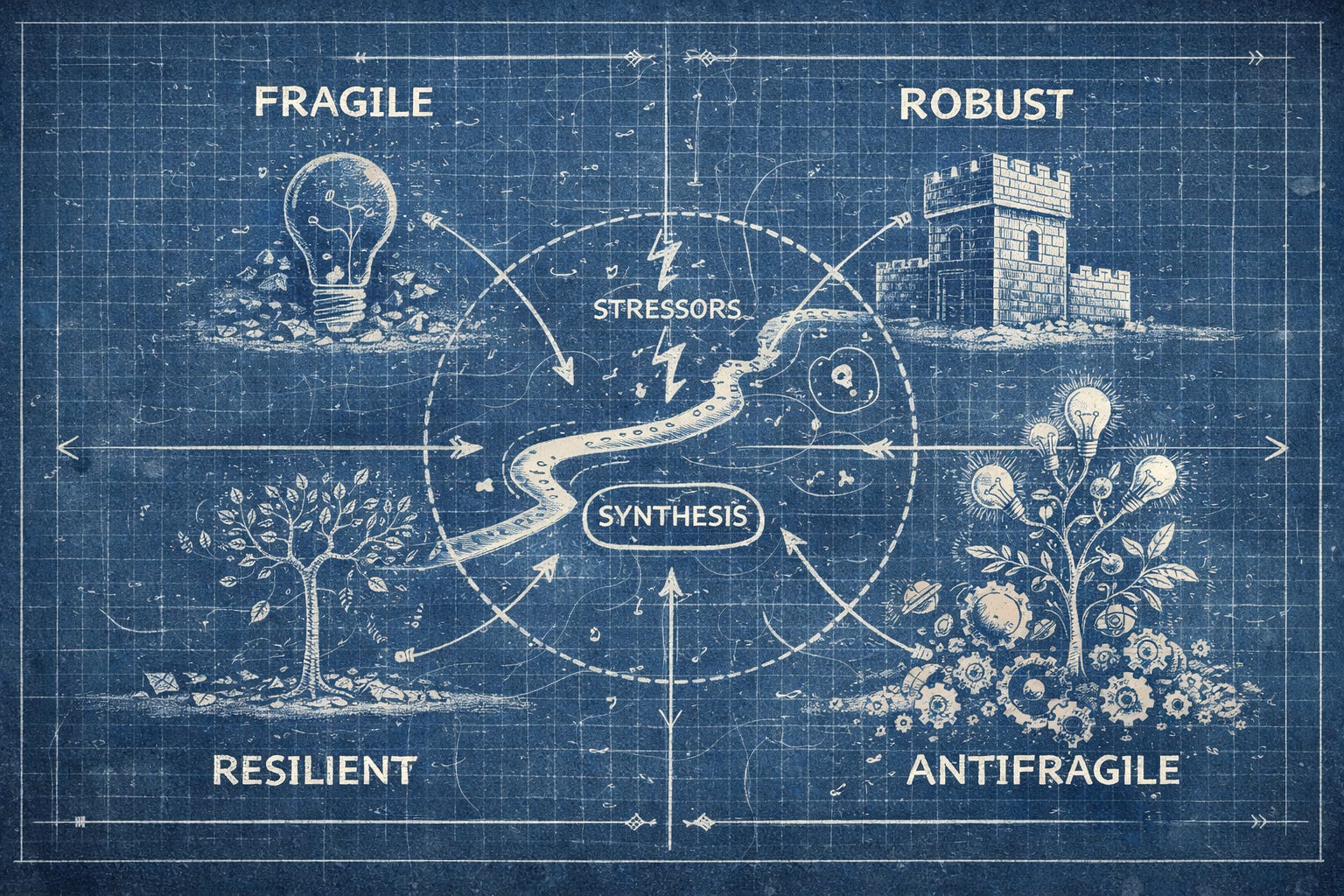
For those who want a more complete architecture, I offer an integration of the research into what I call the Antifragile Synthesis Model—a four-quadrant system designed to build capability that grows stronger under stress.
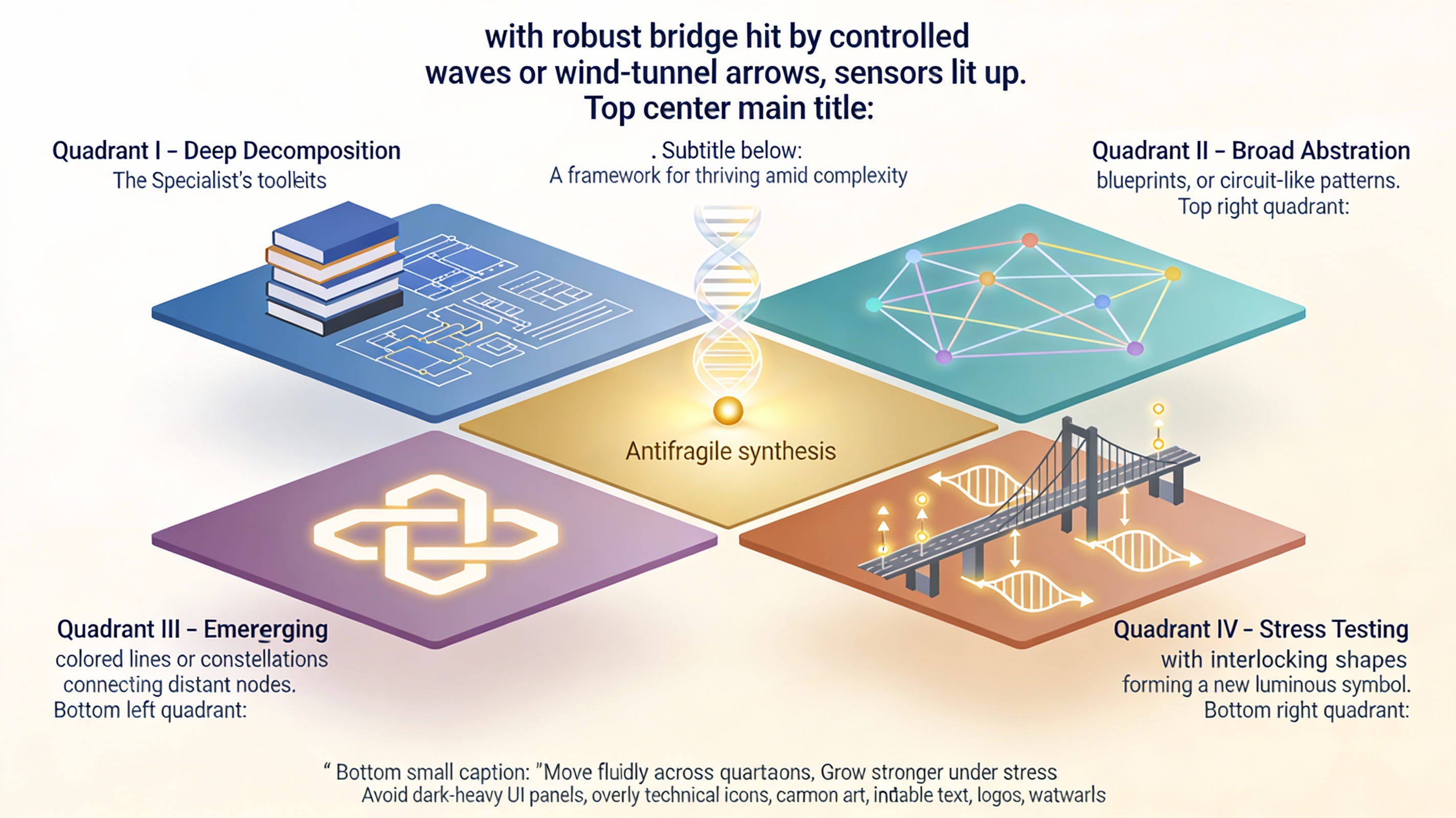
Quadrant I: Deep Decomposition (The Specialist’s Toolkit)
Focus: Mastering domain-specific decomposition patterns through deliberate practice.
This is where you build the 50,000 chunks of a chess master—the internalized patterns that allow rapid recognition of meaningful structure. The goal is to internalize decomposition patterns so thoroughly that they become automatic, freeing cognitive resources for higher-order synthesis.
Expertise reversal warning: Once patterns are internalized, forcing explicit decomposition becomes counterproductive. This quadrant serves acquisition, not permanent operation.
Quadrant II: Broad Abstraction (The Generalist’s Mindset)
Focus: Cross-domain pattern recognition and conceptual blending.
Longitudinal talent development research refutes the “early specialization” myth. Across elite domains, individuals who reach peak performance later tend to have followed broader, more exploratory developmental paths. Early specialization correlates with burnout and career fragility.
This quadrant cultivates the T-shaped or M-shaped profile: deep expertise (vertical) combined with breadth enabling synthesis across domains (horizontal). Each new domain multiplies rather than adds to existing capability through combinatorial possibilities.
Quadrant III: Emergent Synthesis (The Innovator’s Leap)
Focus: Generating genuinely novel combinations from deep and broad knowledge.
This is where the creative leap occurs. The synthesis is not assembly but emergence—new properties and possibilities that exist in no individual component. This quadrant embraces uncertainty and acknowledges that outcomes cannot be fully predicted from inputs.
The research on polymathic thinking supports this: insatiable curiosity (breadth for synthesis), rapid profundity (efficient decomposition-synthesis cycles), and conceptual blending (advanced synthesis across domains) distinguish breakthrough innovators.
Quadrant IV: Stress Testing (The Antifragile Feedback Loop)
Focus: Deliberately exposing synthesized solutions to stressors and adversarial critique.
This quadrant operationalizes the lessons from innovation failures. SpaceX’s success came not from avoiding explosions but from systematically decomposing failure data and synthesizing improvements. Theranos’s collapse came from refusing to honestly synthesize the gap between claims and reality.
Methods include Failure Mode and Effects Analysis (FMEA), pre-mortems, red-teaming, and real-world deployment with rapid feedback loops.
The key insight: The model is non-linear. You might start by exploring broadly (II), dive into deep research (I), have a moment of insight leading to synthesis (III), and immediately begin stress-testing (IV). The ultimate advantage lies in fluid navigation between quadrants.
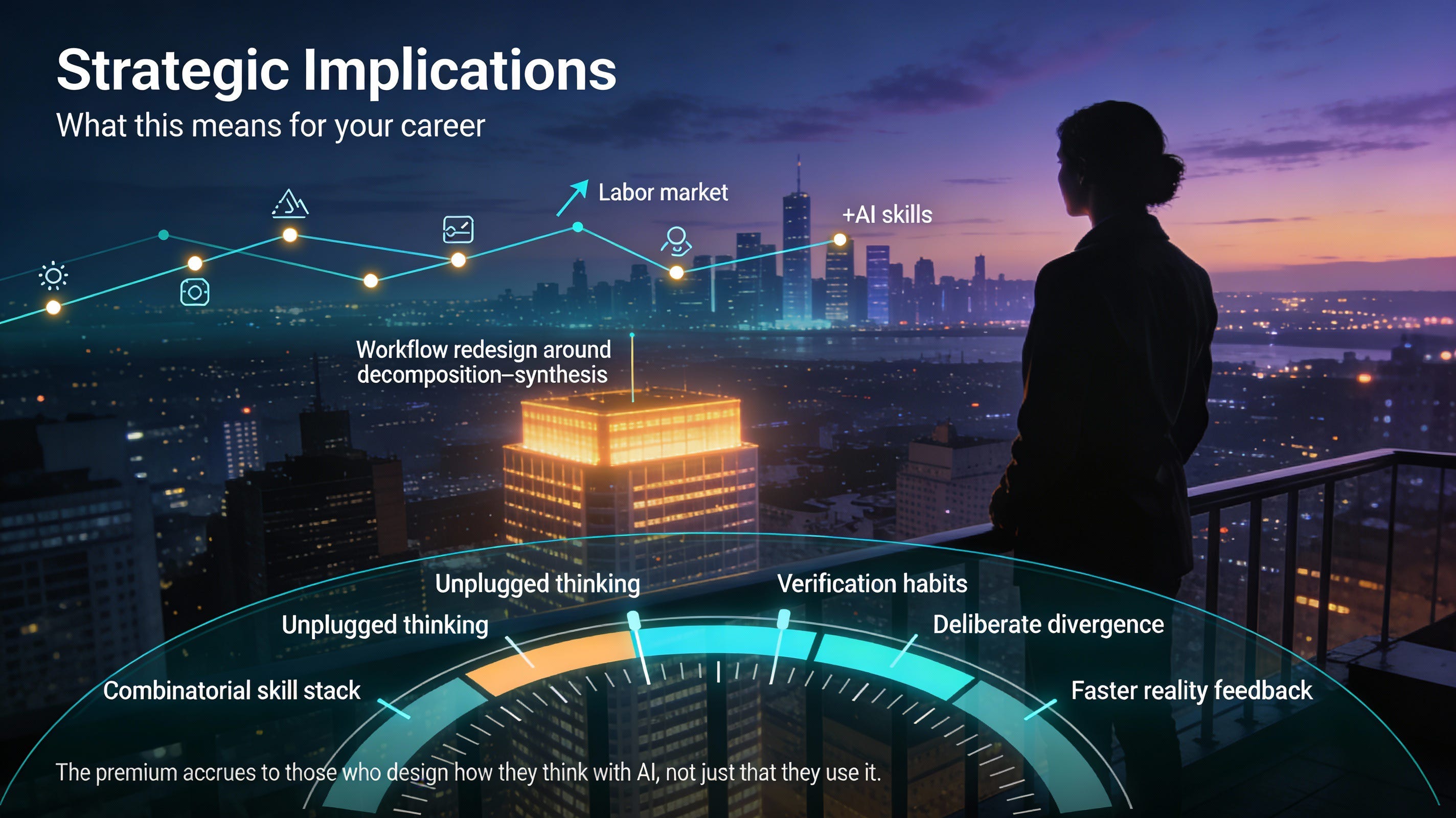
Strategic Implications: What This Means for Your Career
The Labor Market Shift
Value is migrating. Research by David Deming found jobs requiring both analytical and social skills grew by nearly 12 percentage points as a share of U.S. labor force from 1980-2012, while the return to social skills more than doubled.
PwC’s analysis of ~1 billion job ads found AI-skilled workers earn an average premium of 56% over similar jobs not requiring AI skills. But “AI skills” without decomposition-synthesis mastery produces the 95% of companies failing to capture value.
The premium increasingly accrues to those who can:
Determine what to decompose and how (strategic framing)
Synthesize AI outputs into genuinely novel combinations (not just assembly)
Navigate the jagged frontier between AI capability and AI limitation
Maintain independent judgment while leveraging parallel exploration
The Organizational Shift
Companies are discovering that “rolling out AI tools” produces minimal returns. The organizations capturing value are redesigning workflows around the decomposition-synthesis cycle:
Workflow design becomes a core competence, not a support function
Hybrid teams combine human strategic framing with AI parallel execution
Feedback velocity matters more than plan sophistication
Cognitive diversity must be preserved against homogenization pressure
The Individual Shift
If you’re reading this as someone concerned about your own trajectory, the practical implications are:
Invest in unplugged cognitive work. Regularly practice decomposition and synthesis without AI assistance. This is not nostalgia—it’s cognitive maintenance that prevents the atrophy the research documents. The uncomfortable truth: cognitive struggle is the price of durable mental models. The friction of working through a problem yourself—the false starts, the dead ends, the moments of confusion before clarity—is precisely what builds the neural architecture that enables expert intuition. Outsource that struggle, and you outsource the capability formation itself.
Build verification habits. Before accepting any AI output, form your own hypothesis. The skill of recognizing when AI is wrong is more valuable than the skill of prompting AI for answers.
Seek divergence deliberately. When AI outputs feel right, ask for alternatives. The homogenization risk is real; your job is to find the unconventional synthesis that AI’s training toward statistical median cannot produce.
Compound across domains. The mathematics of combinatorial skill compounding create exponential advantages. An individual in the top 10% in two uncorrelated skills occupies a position shared by only 1% of the population. Adding a third domain at the same level creates a 0.1% position.
Accelerate cycles, not plans. Use AI’s speed to get faster feedback from reality, not to produce more elaborate analysis before acting.
A Note on What Won’t Work
Let me be direct about what this article is not recommending:
Not prompting tricks. The skill isn’t in the phrasing of your AI requests. It’s in the cognitive architecture you bring to the conversation. Better prompts from a weak decomposer produce polished mediocrity.
Not “AI literacy” courses. Most corporate AI training teaches tool features, not thinking patterns. Knowing which button to click is not the scarce resource.
Not working longer hours with AI. The research shows AI-enabled speed creates pressure for more output, not deeper thought. The trap is filling reclaimed time with more execution rather than more reflection.
Not abandoning AI in reaction. Pure skeptics who refuse engagement miss the parallelism advantage. The answer isn’t less AI—it’s more deliberate AI combined with maintained independent capability.
The unsexy truth: the advantage comes from the slow, difficult work of building genuine decomposition-synthesis expertise, then amplifying that foundation with AI. There’s no shortcut past the foundation.
The Question of Access
I’ve written primarily for individuals, but I should acknowledge the structural context.
Not everyone has access to the AI tools, computational resources, or knowledge work positions where these skills create leverage. The research on who benefits from AI shows stark demographic patterns: higher-wage, higher-education workers adopt AI at significantly greater rates (12.8% versus 3.3% in Japanese survey data).
The democratization narrative—that AI will level hierarchies—may prove as false as the 1960s predictions of leisure societies that never materialized. Herman Kahn predicted a four-day workweek and 13 weeks of vacation; economists estimated the average 2000 workweek would be 15 hours. Technology transformations rarely unfold as either enthusiasts or pessimists predict.
If you’re reading this with structural access to these opportunities, the responsibility is to use them well. If you’re reading this without such access, the honest message is that individual skill development, however valuable, operates within constraints that individual effort alone cannot overcome.
The Conditional Brightness
I promised at the outset to lead with uncomfortable truths. Here’s the conclusion they point to:
The future is conditionally bright for those who master the virtuous circle of decomposition and synthesis. The condition is not trivial.
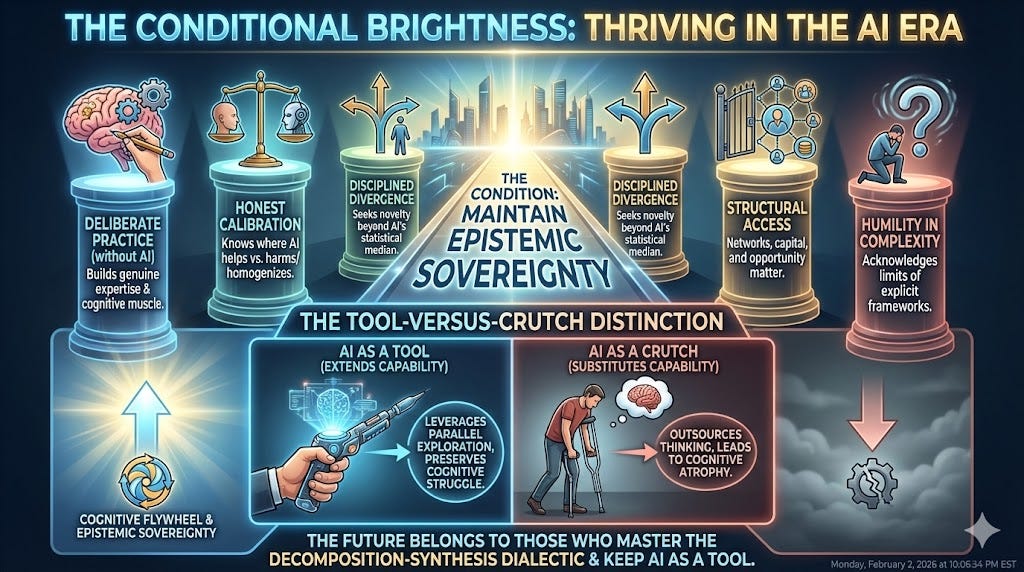
The condition is maintaining epistemic sovereignty—the capacity to think independently while leveraging AI’s parallel exploration capabilities.
This requires:
Deliberate practice of decomposition-synthesis cycles, including cycles without AI
Honest calibration of where AI helps versus where it harms or homogenizes
Disciplined divergence from AI-suggested outputs when synthesis demands novelty
Structural access to the networks, capital, and opportunities that translate capability into outcomes (acknowledging that skill alone doesn’t guarantee success)
Humility about the limits of explicit frameworks in the face of genuine complexity
The meta-analysis showing human-AI teams underperforming isn’t a refutation of AI’s value. It’s a warning about undisciplined AI adoption. The teams that failed weren’t using AI deliberately—they were deferring to it, outsourcing the cognitive work that separates understanding from output.
The dividing line of the next decade won’t be who uses AI versus who doesn’t. It will be who uses AI to deepen their capacity to think versus who uses AI to avoid thinking.
This is the tool-versus-crutch distinction at its starkest. A tool extends capability you already possess; a crutch substitutes for capability you should be developing. The same AI system can function as either, depending entirely on how you deploy it. The practitioners who thrive will be those who maintain the discipline to keep AI firmly in tool territory—leveraging its parallel exploration power while preserving the cognitive struggle that builds genuine expertise.
For the former, the cognitive arbitrage window is wide open. Each decomposition-synthesis cycle builds pattern recognition that makes the next cycle more powerful. Each successfully navigated problem at the jagged frontier develops calibration that transfers to the next frontier. Each deliberate practice session without AI strengthens the muscles that AI cannot replace.
The flywheel doesn’t spin itself. But for those who start it spinning with discipline, humility, and genuine engagement with hard problems—the compounding has only begun.
The most valuable insight from synthesizing this research: As AI commoditizes decomposition, synthesis becomes the scarce, high-value resource. But synthesis value is conditional on maintaining the cognitive struggle that creates durable mental models. The future belongs not to pure decomposers, but to those who master the decomposition-synthesis dialectic—and maintain the discipline to keep AI as a tool rather than a crutch.
Coda: The Orchestration Helix
I want to leave you with one final framework that emerged from synthesizing the research—what I call the Orchestration Helix.
Traditional metaphors frame human-AI collaboration as a partnership or tool use. But neither captures what the evidence suggests about effective integration.
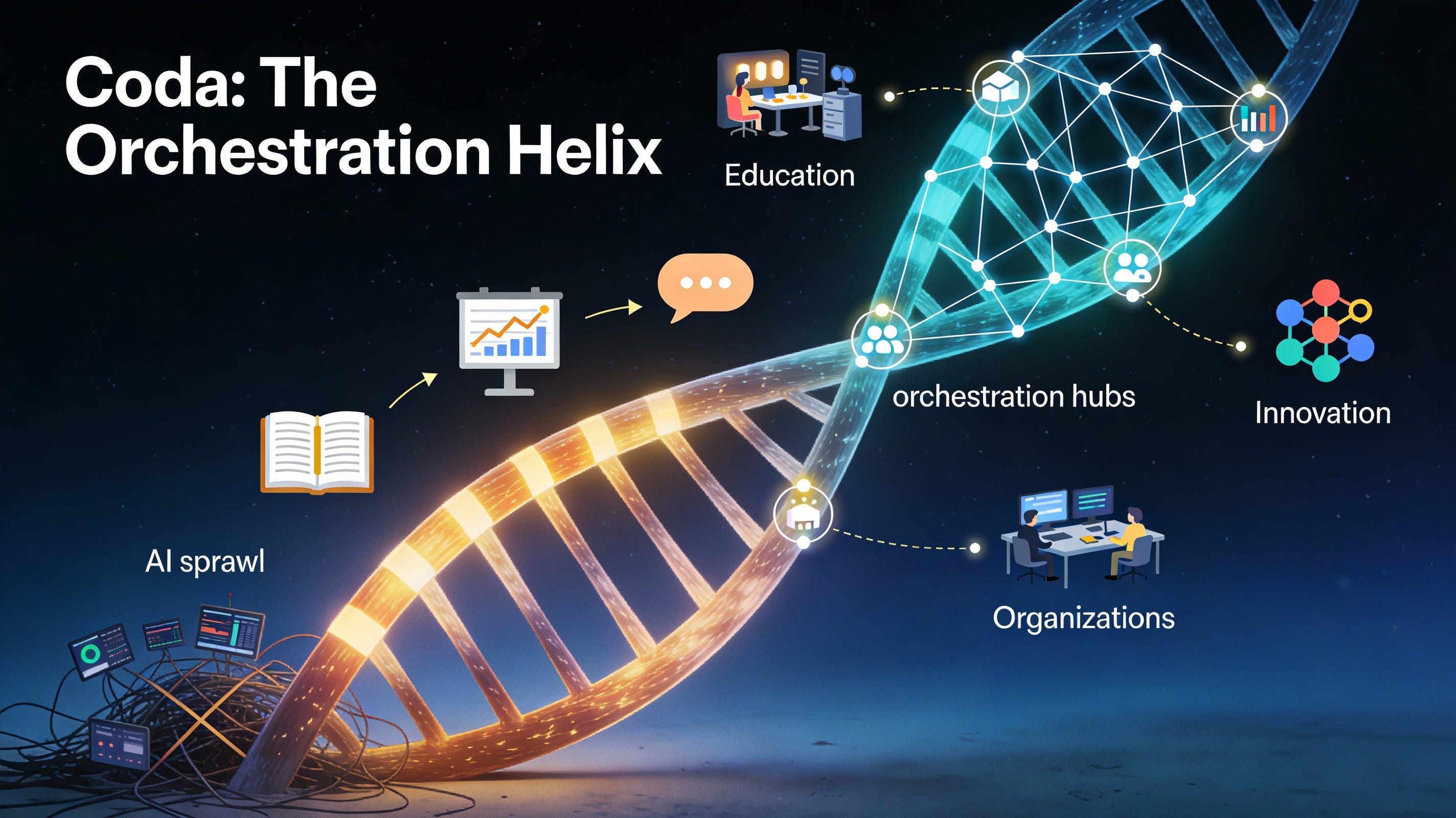
The helix metaphor works better: decomposition and synthesis form a spiraling progression, intertwined with AI agent orchestration at multiple scales. Each revolution of the helix:
Decomposes problems into tasks for specialized AI agents (one for data analysis, another for red-teaming, a third for historical precedent)
Synthesizes their outputs through human judgment
Creates feedback that refines the next round of decomposition
The helix incorporates feedback loops where synthesis outcomes inform future decompositions, creating what the researchers call “exponential adaptability.” Unlike a circle that returns to its starting point, a helix ascends—each cycle building on the last.
In education, this could manifest as curricula emphasizing “AI-conducted symphonies” where students decompose real-world challenges and synthesize AI-assisted simulations. In organizations, it suggests “synthesis hubs”—interdisciplinary teams that decompose global challenges and synthesize AI-driven scenarios with built-in adversarial stress-testing.
The contrarian check on this framework: orchestration can become over-engineering. The same research that supports sophisticated human-AI integration warns of “AI sprawl” where coordination overhead exceeds benefits. The helix is a map, not the territory. Reality will be messier.
But the direction is clear. The future favors neither pure human cognition nor pure AI execution. It favors orchestrated synthesis—human strategic framing directing AI parallel exploration, with explicit mechanisms to preserve cognitive diversity, prevent atrophy, and maintain the epistemic sovereignty that makes the whole system more than a very expensive autocomplete.
The window is open. The flywheel awaits. The question is whether you’ll use this moment to build the cognitive architecture that compounds—or let the tools think for you until you’ve forgotten how.

-for the Esteemed Citizen of the Periphery at Foundation’s Edge
This analysis represents personal research and independent industry analysis based solely on publicly available data from providers, vendors, and industry research firms. All Views are entirely my own and based only on public information; they do not represent any employers past or present or any affiliate.